
How to Choose a Language Learning Method That Fits You Best
TL;DR
The best language learning method depends on your goal (fluency vs travel vs exams), your available time, and how your memory works best. Apps like Duolingo suit habit-building; SRS tools suit vocabulary retention; tutors suit speaking practice. Most successful learners combine two or three methods. This guide shows you exactly how to choose.
Knowing how to choose a language learning method that fits your situation is the difference between steady progress and months of wasted effort.
The honest truth is there is no single best method. What works depends on your specific goal, your schedule, your budget, and whether you tend to learn better alone or with feedback. The problem is that most guides either push one method or list every method without telling you which fits which person.
This guide does something different. It gives you a decision framework: a way to match your actual situation to the methods backed by research, so you stop guessing and start moving.
How to Choose a Language Learning Method: What Actually Matters
The best language learning method is the one that fits your specific goal, schedule, budget, and learning style. There is no universal answer because fluency is not a single destination, a traveller needs different skills than someone preparing for a professional exam, and their ideal methods differ accordingly.
Research on task-based language teaching (TBLT), published in the International Journal of Advanced and Applied Sciences, reviewed 64 studies and found that learning methods focused on real-life communication tasks consistently outperformed generic study for fluency and confidence. The lesson: the closer your method mirrors your actual goal, the faster you progress.
The 4 Questions to Ask Before Choosing Anything
Before comparing any tools or methods, answer these four questions honestly:
- What is my goal? Travel, business, exams, heritage language, or full fluency, each needs a different primary method.
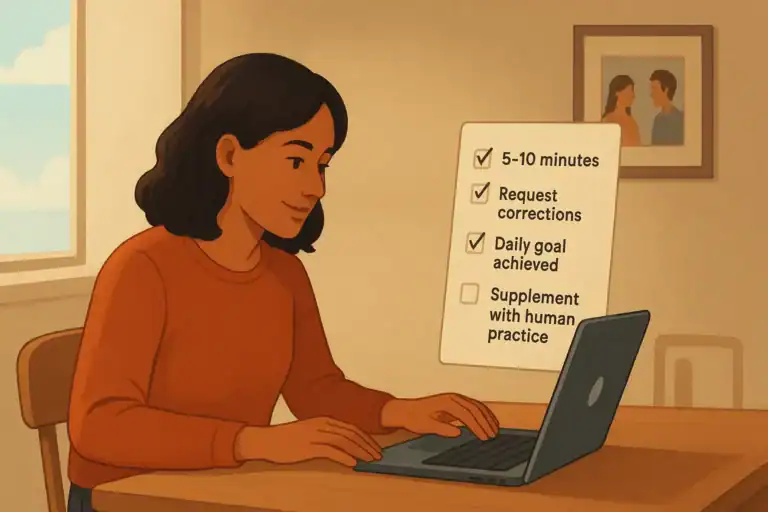
- How much time can I commit daily? Even 20 minutes a day beats two hours on weekends. Consistency matters more than volume.
- What is my budget? Free options (Anki, YouTube immersion) are highly effective. Paid options (tutors, Babbel, structured courses) accelerate specific skills.
- Do I learn better alone or with feedback? Self-directed learners thrive with apps and SRS. Those who plateau without accountability benefit more from tutors or language exchanges.
Know Your Target: What the CEFR Levels Actually Mean
CEFR (Common European Framework of Reference for Languages) is the international standard for measuring language ability, running from A1 (beginner) to C2 (near-native proficiency). It is used by schools, employers, and exam boards worldwide.
Knowing your target CEFR level is essential because it tells you how many hours of study are realistic and which method will get you there fastest. Most casual learners aim for B2 (upper-intermediate), which allows comfortable conversation, reading, and professional use. B2 is achievable in a Romance language in approximately 500 to 650 hours of focused study for English speakers, according to Foreign Service Institute (FSI)
Not sure where you currently sit? language assessment apps that track your CEFR progress can give you a baseline in minutes.
Level | What You Can Do | Hours Needed* | Practical Milestone |
|---|---|---|---|
A1 | Basic greetings, simple questions | 50–100 hrs | Order food, introduce yourself |
A2 | Familiar topics, short exchanges | 150–200 hrs | Navigate a short trip abroad |
B1 | Everyday situations, opinions | 300–400 hrs | Hold a simple conversation |
B2 | Fluent on most topics, professional use | 400–600 hrs | Work or study in the language |
C1 | Complex texts, nuanced expression | 600–850 hrs | Academic or advanced professional use |
C2 | Near-native mastery | 1,000+ hrs | Understand virtually everything |
*Hours are FSI estimates for Category I languages (Spanish, French, Italian, Dutch) for English speakers. Category IV languages like Mandarin or Arabic require 2,000+ hours to B2.
B2 is generally considered the practical fluency threshold. At B2, you can handle most real-world situations without preparation, debates, job interviews, films without subtitles. The question of whether B2 counts as ‘fluent’ is one of the most searched language questions online: it is independent fluency, though not native-level polish. Most educated native speakers operate between C1 and C2.
The 80/20 Rule for Language Learning and Why It Changes Everything
The 80/20 rule in language learning means focusing on the 20% of vocabulary and grammar that covers 80% of everyday conversation. In practice, this means prioritising the most frequent 1,000 to 3,000 words in your target language before anything else.
Research supports this narrowly focused approach. The most common 3,000 words in any language cover roughly 90% of everyday conversation, according to vocabulary frequency research. Native speakers use 20,000 to 30,000 words total, but you do not need anywhere near that number to function comfortably.
The practical takeaway is to resist the urge to study everything. Pick a frequency word list for your target language, use spaced repetition to lock in those words, and layer grammar and listening on top, not the other way around.
For a step-by-step plan that applies exactly this principle, prioritising high-frequency vocabulary and structured AI tools this AI-powered language learning plan is a practical starting point.
The Main Language Learning Methods Compared
The six most widely used language learning methods are spaced repetition, immersion, app-based learning, online tutoring, grammar-focused study, and comprehensible input. Each suits different goals and learning styles, and most successful learners combine two or three rather than relying on any one approach alone.
Spaced Repetition Systems (SRS), Best for Vocabulary Retention
Spaced repetition is a technique that schedules reviews at increasing intervals just before you would naturally forget a word. It is the most evidence-backed method for vocabulary retention.
Without reinforcement, people forget up to 50% of new material within one hour, a pattern first documented by Hermann Ebbinghaus in 1885 and consistently replicated since. Modern spaced repetition systems counter this directly. A 2025 clinical study published in PMC found that students using SRS scored significantly higher on post-tests (16.24) than those using traditional methods (11.89). Research compiled by Suffolk University Law Review across multiple SRS studies found retention rates of 92% compared to traditional cramming.
Best for: vocabulary building, exam preparation, maintaining a language you already know partially.
Main tools: Anki (free, highly customisable), Clozemaster (context-based SRS), MosaLingua.
If you want to go deeper on how interval-based review actually works, how spaced repetition builds vocabulary faster than any other method breaks down the science and the tools worth using.
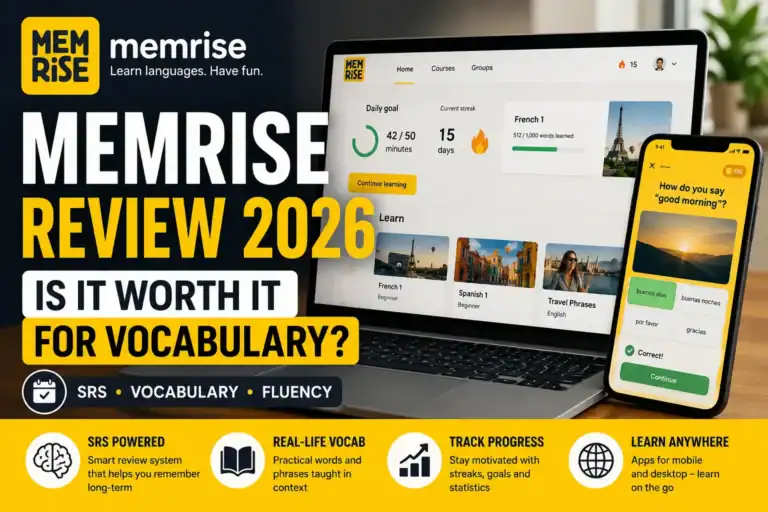
Two of the most effective SRS tools for language learners are compared in depth in the Clozemaster review and Anki vs Memrise vs MosaLingua.
Immersion Learning, Best for Advanced Learners and Full-Time Commitment
Immersion means surrounding yourself with the target language as much as possible: living abroad, watching TV without subtitles, reading books, thinking in the language. It compresses timelines significantly, living in a country while actively studying can shorten the path to B2 compared to studying at home.
Full immersion is not realistic for most people. But partial immersion, like changing your phone language, watching your favourite series dubbed in your target language, or listening to podcasts during a commute adds meaningful passive exposure on top of active study.
Best for: intermediate to advanced learners, those relocating, or those with high daily exposure to the target language.
Not recommended as a starting point: without a basic vocabulary foundation (A1/A2), immersion produces frustration rather than learning.
App-Based Learning, Best for Habit Building
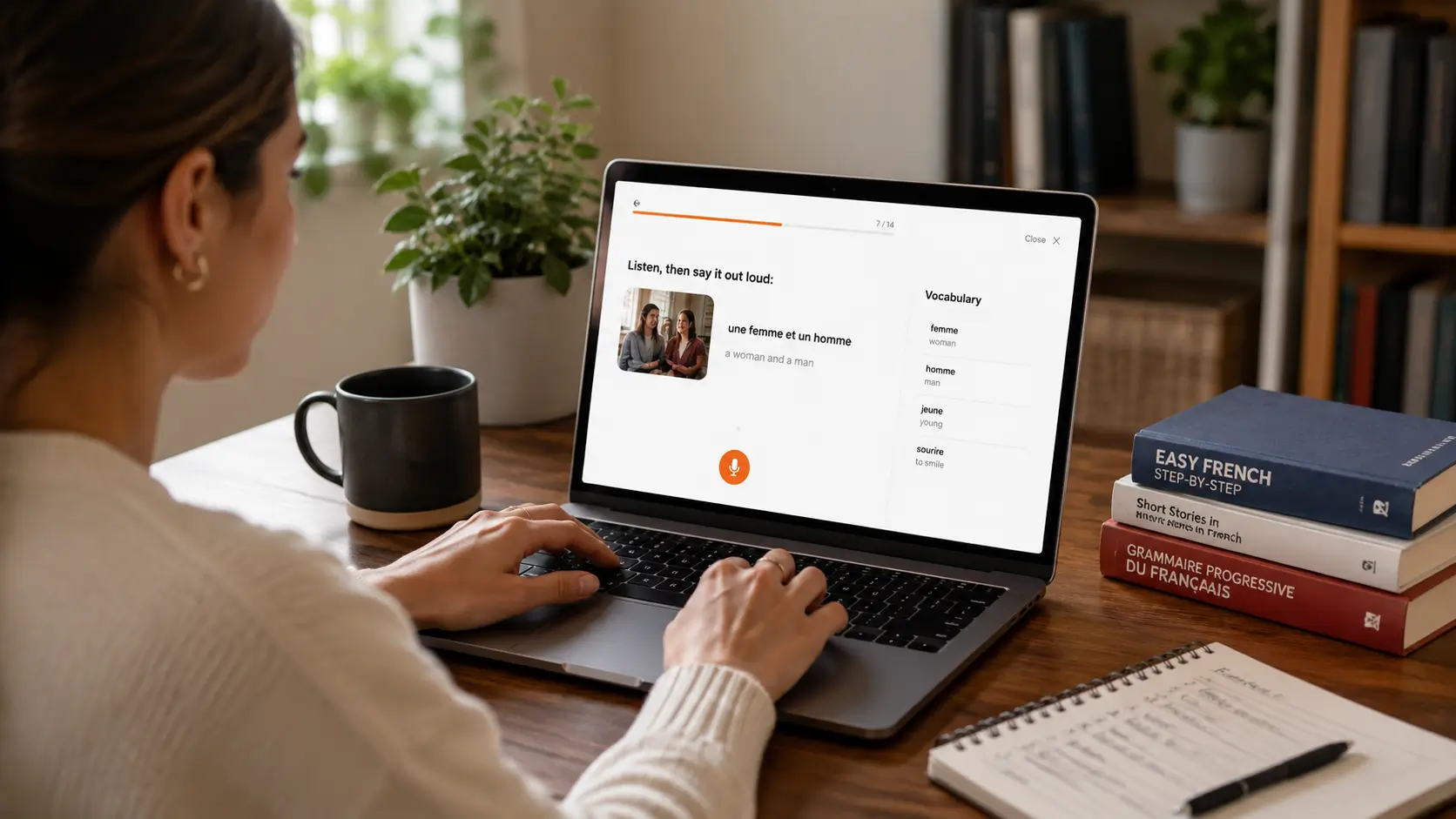
Language apps are the most popular entry point for learners worldwide, but their effectiveness varies widely depending on the app and how it is used. Apps are excellent for building a daily study habit; they are poor substitutes for structured grammar instruction or speaking practice.
Duolingo crossed 50 million daily active users in 2025 but has faced consistent community criticism over declining content quality following its AI-first pivot. Five-star reviews in app stores dropped from 60% to approximately 30% by mid-2025. Users and analysts report the platform prioritises gamification engagement over language acquisition outcomes.
My honest assessment: Duolingo is useful for daily habit-building and total beginners. It is not sufficient as a standalone path to fluency.
Babbel takes a more structured, grammar-forward approach. A study by the City University of New York (CUNY) found that 15 hours of Babbel use equates to one semester of university-level Spanish. Babbel is also one of the stronger structured options at this price point, the Babbel review breaks down its methodology and who it works best for.
Best for: building the daily study habit, beginners filling vocabulary gaps, keeping an existing language warm.
Avoid relying on either app as your only method if B2 fluency is the goal.
If you’re still deciding which app to start with, the best language learning apps for beginners ranks the top options by learning style and goal, not just popularity.
There is a reason streaks and XP keep you opening the app, how gamification works in language learning explains the psychology, and when it actually helps vs when it gets in the way.
Online Tutoring, Best for Speaking Confidence
Working with a live tutor or language exchange partner is the most direct method for building spoken fluency. No app replicates the accountability and real-time correction of a human conversation partner.
Tutoring accelerates progress most at A2 and above, where learners have enough vocabulary to hold a conversation but need to work on natural expression, accent, and spontaneous speaking. Platforms like Preply, iTalki, and Talkio (AI-powered) all offer different trade-offs between cost and human interaction.
For learners who prefer a structured school format over a personal tutor, Lingoda offers scheduled group classes with a fixed CEFR curriculum, a different model to both marketplace tutoring and AI conversation tools.
Best for: speaking confidence, business language goals, advanced learners who have hit a plateau.
Cost: human tutors typically $10 to $40 per hour on platforms iTalki vs Preply; AI conversation tools considerably less.
Not sure whether to pay for a tutor or use a language exchange partner? This comparison of tutoring platforms and language exchanges covers the real cost-benefit difference.
Grammar-Focused Study, Best for Exam Learners and Analytical Thinkers
Traditional grammar study, like textbooks, structured courses, explicit rule learning is not as out of fashion as some app-centric marketers suggest. For learners preparing for formal exams (DELF, DELE, Goethe, IELTS), understanding grammatical structure directly improves reading comprehension and written accuracy.
The limitation is output practice. Grammar study without speaking or writing practice produces learners who understand rules but cannot use the language spontaneously. It works best when combined with SRS for vocabulary and regular conversation practice.
Best for: exam preparation (B2/C1 certifications), analytical learners, building accurate written language.
Comprehensible Input, Best for Intermediate Learners
Comprehensible input, based on Stephen Krashen’s i+1 theory, means exposing yourself to target-language content that is just slightly above your current level. Graded readers, podcasts designed for learners (Dreaming Spanish, Pimsleur, News in Slow), and dubbed TV series all qualify.
This method is most effective between B1 and B2, where a learner has enough vocabulary to follow content but still encounters enough unfamiliar material to make progress. It is low-effort in the sense that it can replace passive entertainment, making it one of the most sustainable long-term strategies.
Best for: intermediate learners, maintaining progress without structured sessions, building listening comprehension.

Study Method Frameworks, Which One Fits Your Schedule?
Study method frameworks like the 15/30/15 split, the Pomodoro technique, and the 7-3-2-1 review schedule are timing structures, not learning methods themselves, but they dramatically affect how much of what you study actually sticks.
The most important insight from memory research: daily short sessions outperform long infrequent ones. Twenty minutes of focused daily practice produces better retention than a two-hour weekend session, because consistent retrieval strengthens neural pathways in ways that cramming does not.
The Main Timing Frameworks
- 15/30/15 method: 15 minutes of new vocabulary, 30 minutes of core study (grammar or listening), 15 minutes of review. Good for 1-hour daily sessions.
- 7-3-2-1 review schedule: Review new material after 7 days, then 3 days, then 2 days, then 1 day of final reinforcement. A simplified form of spaced repetition that can be done with any flashcard set.
- The Golden List method: Write 25 new words longhand, review without highlighting or re-reading, discard any you knew, and repeat with only the words you missed. Forces active recall and works particularly well for vocabulary that resists SRS.
- Pomodoro (25-5-25): 25 minutes of focused study, 5-minute break, repeat. Useful for grammar study or reading; less useful for SRS which already controls its own timing.
Key takeaway:
20 minutes of focused daily practice beats 2 hours on weekends. Consistency, not volume, builds lasting neural connections and the research is unambiguous on this point.
If you want your study schedule to adapt automatically to what you are forgetting, how adaptive learning personalises language app progress explains how the best AI-powered apps now do this for you.
How to Choose Based on Your Goal
Match your primary goal to the method and tools most likely to get you there. The table below is designed as a decision shortcut, not a rigid prescription, most successful learners layer two or three approaches.
Your Goal | Primary Method | Top Tools | Target Level | Realistic Timeline* |
|---|---|---|---|---|
Travel / Holiday | App + Comprehensible Input | Babbel, podcasts, Pimsleur | A2–B1 | 3–6 months |
Business / Work | Tutoring + Grammar Study | Preply, iTalki, Lingoda textbook | A2–C1 | 12–24 months |
Language Exams | Grammar Study + SRS | Anki, structured course | B2–C1 | 6–18 months |
Full Fluency | Immersion + SRS + Tutor | Anki, iTalki, native content | B2–C2 | 18–36 months |
Heritage Language | Comprehensible Input + Tutor | Native media, tutor | B1–B2 | 6–12 months |
Maintain Existing | SRS + Comprehensible Input | Anki, Clozemaster, podcasts | Maintain C.L. | Ongoing |
*Timelines assume 30 to 60 minutes of daily study for Category I languages (Spanish, French, Italian). Category IV languages (Mandarin, Arabic, Japanese) require two to three times longer.
Once you have decided tutoring is the right fit for your goal, finding the right online language tutor walks you through what to look for before you book a first lesson.
The Biggest Mistakes Language Learners Make
The most common mistake is switching methods too early, abandoning an approach after two or three weeks before it has had time to produce visible results. Most methods require 60 to 90 days of consistent use before meaningful progress becomes apparent.
Other common mistakes that stall progress:
- No clear CEFR target. Studying without a defined goal level means you never know when you are making progress or when to change strategy, which is exactly why it helps to measure progress in speaking a new language on a regular schedule rather than guessing.
- Relying on a single app for fluency. Duolingo and Babbel are starting tools, not complete programmes. Community data consistently shows users who supplement with tutoring, SRS, or reading progress significantly faster than those using apps alone.
- Neglecting speaking practice until ‘ready’. There is no threshold of readiness. Speaking poorly from day one produces faster improvement than waiting for grammar to feel perfect.
- Confusing engagement with learning. Completing streaks, earning XP, and finishing daily app challenges feel productive. If you are not regularly encountering material you cannot understand, you are probably not progressing.
- Studying for long sessions infrequently. A two-hour Saturday session produces less retention than four 30-minute sessions spread across the week, for the same total time investment.
Worth Reading Next
For a broader look at every tool and technology in the language learning space, the ultimate guide to language learning technology covers everything from AI tutors to SRS apps in one place.
- How spaced repetition builds vocabulary faster than any other method
- The best language learning apps for beginners
- Language tutoring vs exchange: how online platforms compare
- How adaptive learning personalises language app progress
Conclusion
Choosing a language learning method is not a one-time decision. It is a framework you revisit every few months as your level, goal, and available time evolve. Here is the short version of everything above:
- Set a CEFR target before choosing any tool or method. Know whether you need A2 for a holiday or B2 for a job.
- Match your method to your goal using the table in this guide. Travel needs different inputs than business fluency.
- Prioritise vocabulary frequency first (the 80/20 rule). The top 3,000 words cover 90% of daily conversation.
- Pick one primary method and give it 60 days before evaluating. Consistency beats method-hopping every time.
- Add a second method for the skill your primary approach misses if you use an app, add SRS or a tutor; if you use SRS alone, add listening input.
The learners who reach fluency are not the ones who found the perfect method. They are the ones who found a good-enough method and showed up every day.
Frequently Asked Questions
Is Babbel or Duolingo better for beginners?
Babbel is better for beginners who want structured grammar instruction and plan to reach conversational fluency. Duolingo is better for building a daily habit and for very casual learners who want low-pressure exposure. Neither is sufficient alone for reaching B2. Duolingo experienced significant quality criticism in 2025 following its AI-first content shift, with app store ratings dropping from 60% to around 30% five-star reviews.
What is the fastest method to learn a language?
Full immersion combined with structured SRS vocabulary study and regular tutor sessions produces the fastest results. FSI data shows intensive full-time study (25 hours per week) can bring English speakers to B2 in a Romance language in roughly 24 to 30 weeks. For self-study learners, combining the 80/20 vocabulary approach with daily SRS and comprehensible input produces the fastest independent-study results.
What does B2 level mean — is it fluent?
B2 (upper-intermediate on the CEFR scale) means you can communicate fluently on most topics, understand the main ideas of complex texts, and interact with native speakers without strain. It is widely considered practical fluency — sufficient for work, study, and everyday life in a target-language country. Native speakers typically operate at C1 to C2.
How many hours a day should I study a language?
Research consistently shows that 20 to 60 minutes of daily focused study produces better long-term retention than longer infrequent sessions. For Category I languages, 30 minutes daily equates to roughly 180 hours per year — enough to move from A1 to B1 in 18 to 24 months. Two hours daily accelerates this significantly, reaching B2 within a single year for motivated learners.
Can you become fluent using only an app?
No. Community data and researcher analysis consistently show that app-only learners plateau at A2 to B1 level because apps do not provide sufficient speaking practice, grammar depth, or exposure to real-world language variation. Apps are most effective as one layer in a broader system, typically for vocabulary and daily habit-building, alongside a tutor, SRS, or immersive content.