
Why Do I Translate in My Head? Causes & Easy Fixes Now
Quick Summary
▸Mental translation isn’t a beginner flaw. It measurably decreases with proficiency, not with fluency alone, according to a Cambridge study of French learners.
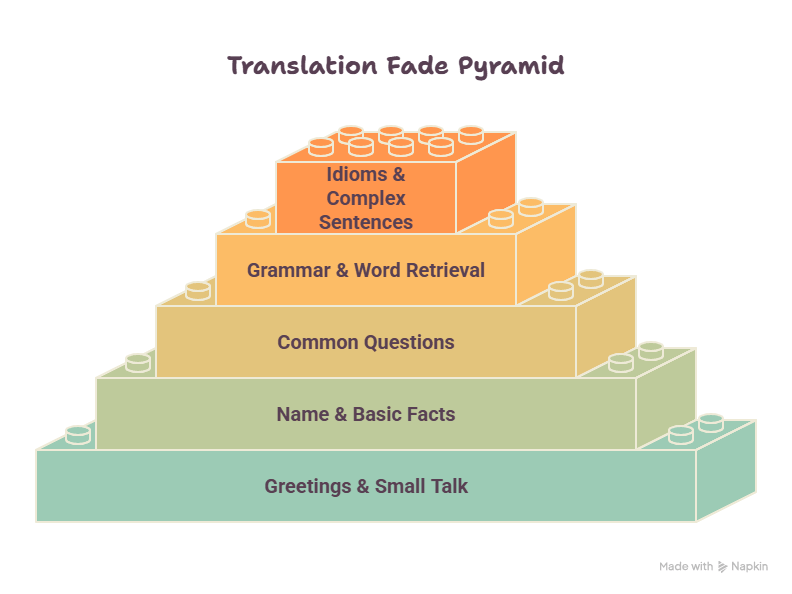
▸Automaticity builds phrase by phrase, not all at once. Greetings and your own name automate long before grammar-heavy sentences do.
▸Bilingual brains keep both languages switched on at the same time. Speaking one requires actively suppressing the other, according to research on bilingual language control.
▸Even fluent multilingual speakers still translate, just for whichever language has had the fewest repetitions, not for every language equally.
▸The fix: pick one phrase category (greetings, self-introduction, common questions) and over-repeat it until it’s automatic, then move to the next.
A Cambridge study tracked intermediate French students over one semester and found something surprising: translation frequency dropped as reading ability rose, but it never dropped to zero, even for the strongest readers. That single finding rewrites the usual story. Mental translation isn’t a switch that flips off once you’re “good enough.” It’s a habit that fades in pieces, on its own schedule, tied to how much practice each piece has had.
If you’re translating in your head before you speak, you’ve probably already been told to just relax, or to trust the process, or to get more exposure. None of that explains what’s actually happening in your brain, and none of it tells you what to do about it today. This post covers both: the real mechanism behind mental translation, and the specific, ordered way to make it fade faster.
Why Do I Translate in My Head?
You translate in your head because your brain is holding two languages active at once and has to actively hold back the one you’re not using. This isn’t a flaw in your setup. It’s how every bilingual brain works, according to neuroscience research on what’s called bilingual language control. Both languages sit ready to fire. Speaking one means suppressing the other in real time.
Translation is the visible evidence of that suppression working overtime. Early on, before a word or phrase has enough reps behind it, your brain hasn’t automated the shortcut yet, so it falls back on the slower, conscious route: think it in the language you know well, then convert it. That conversion step is what you feel as “translating.”
What Causes Mental Translation in the Brain?
The direct cause is a gap between two types of knowledge: declarative and procedural. Declarative knowledge is a rule you look up every time, like checking a chart before you conjugate a verb. Procedural knowledge is a rule you just know, no lookup needed, no delay. Translation is what declarative knowledge feels like from the inside, and it disappears once that same knowledge becomes procedural.
Brain-imaging research on bilingual speakers backs this up at the mechanical level. Managing two active languages recruits specific control regions of the brain, including areas responsible for monitoring conflict and suppressing the language you’re not using. That suppression takes real mental effort, especially for anything you haven’t practiced enough to run on autopilot. Every fresh phrase starts declarative. Repetition is the only thing that moves it into procedural.
Is Translating in My Head Normal?
Yes. It’s a normal, expected part of learning any language past the absolute beginner stage, and it shows up even in learners who are already reading and understanding at a high level. The Cambridge study mentioned earlier found translation use among stronger readers, just far less often, and concentrated in the toughest spots of a text. Translating isn’t proof you’re behind. It’s proof your brain is still building the shortcut for that specific piece of language.
That same hesitation, the gap between understanding something and producing it confidently, shows up constantly in conversation too, which is worth reading about in why you can’t speak a language despite understanding it.
Is Mental Translation a Sign of Fluency?
Not directly, and this is where a lot of advice gets it backwards. Fluency doesn’t erase translation on its own. Repetition erases it, one chunk of language at a time. A fluent speaker in one language can still translate constantly in a second language they’ve barely used, and a beginner can already speak certain fixed phrases without any translation at all, simply because those specific phrases have been repeated so often they became automatic first. Fluency is really just the end result of enough chunks reaching that automatic stage.
Why Does Translation Fade for Some Phrases Before Others?
Because your brain proceduralizes language in the order you actually use it, not in the order a textbook teaches it. The phrases you say constantly (good morning, how are you, my name is) get repeated in nearly every single conversation from day one, so they cross from declarative to procedural fast. Anything rare, like a specific grammar structure or an idiom you’ve heard twice, stays declarative far longer simply because it hasn’t had the reps.
I’m Danish by birth, but I’ve lived most of my life outside Denmark: a year in England at 17, six weeks studying in Germany at 22, three months working in Greece, and time in both the Netherlands and Italy. People always ask what language I think or dream in, and honestly, I can’t say for sure. These days it’s mostly Dutch, though my Danish still surfaces when I swear. I switch between Danish, Dutch, and English without noticing the switch happen.
Italian is different. It’s the one language where I’m not fluent, and I still translate before I speak, especially anything involving grammar or finding the right word. I’m fairly sure I’m translating from Dutch, though it might be Danish underneath that. My case isn’t a contradiction of “translation fades with fluency,” it’s proof of the real rule: it fades by repetition count, not by your overall skill level. Danish, Dutch, and English all have decades of reps behind nearly everything I say. Italian doesn’t, not yet, especially past the small-talk layer.
Idioms, Slang, and Complex Sentences Go Last
These are exactly the categories with the lowest repetition count, so they’re the last to proceduralize. An idiom might come up once a month. A piece of slang might only exist in one context you’ve encountered a handful of times. A complex, multi-clause sentence forces your brain to juggle several rules at once, several of which probably still live in declarative memory. Each of those factors adds translation delay on its own, and they stack.
In my own Italian, this is exactly where I get stuck: not on greetings, which are automatic by now, but on constructing a full grammatically correct sentence on the fly, or reaching for a word that only comes up occasionally. That’s the low-repetition layer still waiting its turn.
Conversations Are Harder Than Reading or Listening
Because producing language is harder than recognizing it. When you’re reading or listening, your brain only has to match incoming words to meanings it already half-knows, which is comprehension. When you’re speaking, your brain has to generate the exact right words and grammar from scratch under time pressure, which is production. Production draws on far more of the same declarative-to-procedural pipeline, all at once, live, with someone waiting on your answer. That’s why conversations feel like the hardest place to escape mental translation, even for material you understand fine on the page.
That pressure to get it right before you even open your mouth is closely tied to why you’re afraid of making mistakes when speaking a foreign language.
Does Everyone Translate the Same Way?
No, and this is rarely discussed. Some learners report they don’t experience a clear “inner voice” translating word for word at all. Instead they describe thinking in images or impressions, and say foreign words simply don’t attach to a feeling yet the way native-language words do. That’s a real and valid variation in how people experience inner speech, not a sign that something is wrong.
My own experience sits somewhere in the middle of these variations. I switch fluidly between three languages without a clear sense of which one is doing the “thinking,” except when I hit Italian, where the translation step becomes obvious again. If your experience doesn’t match a tidy single-inner-voice description, you’re not the only one, and it doesn’t change the underlying mechanism: whichever language pattern has the fewest reps behind it is the one that will feel like translation.
Translating vs. Thinking in the Target Language
Translating | Thinking Directly | |
|---|---|---|
What it feels like | A pause, a mental detour, effortful | Immediate, no detour noticed |
Speed | Slower, noticeable lag before speaking | Near-instant |
Common trigger | Low-repetition words, grammar, idioms | High-repetition phrases, routine exchanges |
What’s happening in the brain | Declarative lookup, active suppression of the other language | Procedural, automatic retrieval |
How Can I Reduce Mental Translation?
Target one phrase category at a time instead of trying to “get more exposure” in general, which is too vague to act on. Pick a small, high-frequency set (greetings, your own name and background, common questions) and repeat it until it stops requiring thought, then move to the next category up in difficulty. This mirrors exactly how the fastest-proceduralizing phrases got there in the first place: sheer repetition count on one chunk before moving to the next.
A few specific exercises that build this kind of targeted repetition:
- Shadowing: repeat native audio out loud in real time, matching rhythm and pronunciation, to build automatic phrase recall.
- Sentence-pattern drilling: take one grammar pattern and practice it with 10-15 different vocabulary swaps until the pattern itself needs no thought.
- Picture association: attach new words directly to an image or feeling instead of to their translation, so the word never routes through your other language at all.
- Graded readers: read material slightly below your level so your brain gets high-volume repetition without constant new-word lookups interrupting the flow.
- Extensive listening: high-volume, low-effort listening (podcasts, shows) to rack up passive reps on structures you’ll later need to produce.
If pronunciation specifically, not just phrasing, is where you’re stuck, how to fix pronunciation problems walks through which sounds are actually worth drilling and which ones don’t affect being understood.
These exercises get you started, but building the actual habit of thinking directly in your target language, rather than translating and then speaking, deserves its own deeper walkthrough, which we’ll cover soon.
Structured conversation practice with a real tutor accelerates this far faster than solo drilling, since a tutor forces you into live production instead of passive review, which is why it’s worth comparing lingoda vs Preply for tutor-led practice. If you want a simple structure to build daily repetition without overplanning it, a daily speaking practice routine lays out a straightforward 7/30/90-day path.
Automaticity is built phrase by phrase, not fluency-wide. Stop expecting an on/off switch, and start repeating one small category until it’s automatic before moving to the next.
When Is Mental Translation Actually Helpful?
Early on, translation is a genuinely useful scaffold, not a bad habit to be ashamed of. Beginners rely on it to bridge meaning while their vocabulary and grammar are still too thin to stand on their own, and that bridge is exactly what lets comprehension happen at all before automaticity has had time to build. Trying to skip straight to “no translation” before you have enough repetitions behind you just adds frustration without speeding anything up.
This same repetition-builds-automaticity idea is exactly how spaced repetition works for vocabulary, which is worth reading if you want to see the mechanism applied to a concrete study method: how spaced repetition works for building vocabulary fast
Worth reading next
A few more useful guides:
- Why You Can’t Speak a Foreign Language Despite Understanding It
- How Long Does It Take to Learn a Foreign Language
Conclusion
Mental translation doesn’t disappear all at once when you become fluent. It fades chunk by chunk, in the order you’ve actually repeated each piece of language, starting with greetings and ending with the rare grammar and vocabulary you barely use. The fastest way to move a category from translated to automatic isn’t vague “more exposure.” It’s picking one small, high-frequency category today and repeating it until it stops requiring thought, then moving to the next.
Frequently Asked Questions
Why do I mentally translate words but understand fine when reading?
Reading only requires comprehension, matching what you see to meaning you already half-know. Speaking requires production, generating the right words and grammar from scratch, which draws on far more declarative knowledge that hasn’t proceduralized yet.
Why do I forget words while translating mid-sentence?
Translating mid-sentence uses up working memory that you also need to hold the rest of your sentence together, so something gets dropped. The fix is the same one that reduces translation overall: more repetition on that specific word or structure.
How long does it take to stop translating in your head?
There’s no single timeline, since it depends on repetition count per phrase category, not on a fixed number of months. High-frequency phrases can stop needing translation within weeks, while rare grammar or vocabulary can take years of occasional use to automate.
Is it bad to still translate in your head as an advanced learner?
No. Even highly proficient readers in the Cambridge study still translated occasionally, just in the hardest, lowest-repetition spots of a text. Advanced simply means fewer categories still need it, not zero.
Why do I translate technical or business terms more than everyday words?
Technical and business vocabulary is usually low-frequency in daily conversation, so it gets far fewer repetitions than greetings or small talk, and stays declarative much longer as a result.