
Language Assessment Apps: Smart Progress Tracking
TL;DR
Language assessment apps help you measure real progress instead of guessing whether your study time is working. The best tools track speaking, listening, vocabulary, and grammar over time, helping you identify weak spots, prepare for exams, and build a smarter study plan based on actual data instead of motivation alone.
One of the hardest parts of language learning is knowing whether you’re genuinely improving or just staying busy. A lot of learners spend months using apps, reviewing vocabulary, and practicing grammar without having a clear picture of what’s actually getting better.
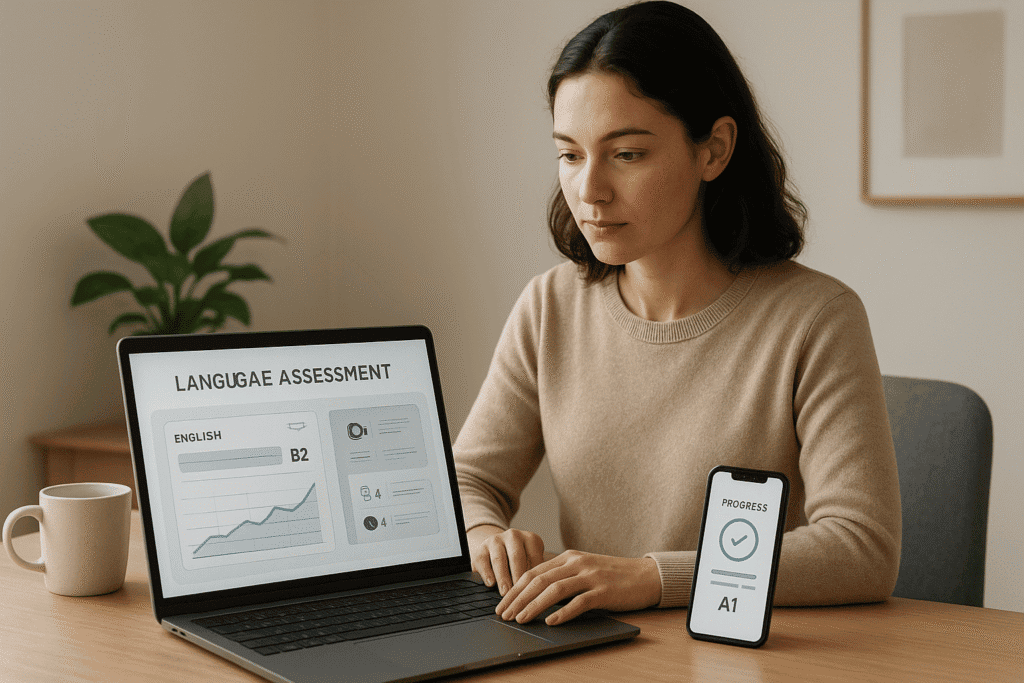
That’s where language assessment apps become surprisingly useful. Instead of relying on streaks or lesson completion, these tools measure real progress across speaking, listening, reading, writing, vocabulary, and grammar. Some even show which specific skills are holding you back so you can stop wasting time on study methods that aren’t moving the needle.
And the timing makes sense. As AI-powered language tools become more personalized, assessment has quietly become one of the most important parts of effective learning. The learners improving fastest usually aren’t the ones studying the most — they’re the ones adjusting based on feedback and progress data.
In this guide, we’ll look at how language assessment apps work, which tools are worth using, how to interpret your results, and how to turn assessment data into a smarter language learning plan.
What You’ll Learn:
- How language assessment apps measure your proficiency
- Top apps for tracking progress across all skills
- CEFR level assessment and certification prep
- Diagnostic tools that identify your weak points
- How to interpret progress data for maximum improvement
What Are Language Assessment Apps?
Language assessment apps are specialized tools that evaluate your language proficiency across multiple dimensions—speaking, listening, reading, writing, vocabulary, and grammar. Unlike general learning apps that teach content, assessment apps specifically measure what you know and how well you can use it.
Core functions:
Proficiency testing: Determine your current level on standardized scales (CEFR A1-C2, ILR, ACTFL)
Progress tracking: Monitor improvement over time with quantifiable metrics.
If you want to build an actual study system around those progress metrics, an AI language learning plan helps connect assessment data to daily practice decisions.
Skill diagnostics: Identify specific strengths and weaknesses across language competencies
Gap analysis: Reveal which skills need more practice to reach your goals
Certification preparation: Assess readiness for official language exams
The best assessment apps combine automated testing with intelligent analytics, providing insights that help you optimize study time and focus efforts where they’ll have the greatest impact. we approach language acquisition.
A lot of these platforms now rely on adaptive learning systems that automatically adjust lesson difficulty based on your performance and retention patterns.
Understanding Language Proficiency Scales
Before diving into specific apps, understanding standard proficiency frameworks helps you interpret assessment results accurately.
CEFR Levels (Common European Framework of Reference)
The most widely recognized scale worldwide:
A1 (Beginner): Can understand and use familiar everyday expressions. Basic phrases for immediate needs.
A2 (Elementary): Can communicate in simple, routine tasks. Describes background, immediate environment.
B1 (Intermediate): Can handle most travel situations. Describes experiences, dreams, ambitions. Explains opinions.
B2 (Upper Intermediate): Can interact with native speakers with fluency. Understands complex texts. Detailed discussions on wide topics.
C1 (Advanced): Can use language flexibly for social, academic, professional purposes. Produces clear, well-structured detailed text.
C2 (Mastery): Can understand virtually everything. Summarizes information from different sources. Expresses spontaneously with precision.
Most assessment apps calibrate their testing to CEFR standards, making results internationally comparable.
Other Common Scales
ILR Scale (Interagency Language Roundtable): 0-5 scale used by US government agencies
ACTFL Proficiency Guidelines: Novice, Intermediate, Advanced, Superior, Distinguished levels used in US education
Understanding these frameworks helps you set realistic goals and interpret progress meaningfully.

Top Language Assessment Apps for Progress Tracking
Duolingo English Test
Best for: Official English proficiency certification accepted by universities and employers
Key features:
- Complete adaptive test in 1 hour from home
- Tests reading, writing, listening, speaking
- Results available within 48 hours
- Scores accepted by 4,000+ institutions worldwide
- Significantly cheaper than TOEFL/IELTS ($59 vs $200+)
Assessment methodology: Adaptive testing adjusts difficulty based on your responses, providing accurate proficiency measurement in minimal time.
Progress tracking: While primarily a certification tool, repeated testing (every 30 days) tracks improvement over time.
Best for: English learners needing official certification for university admissions, job applications, or immigration.
DIALANG
Best for: Free CEFR-based assessment across 14 languages
Key features:
- Tests reading, writing, listening, grammar, vocabulary
- Provides detailed CEFR level assessment (A1-C2)
- Completely free diagnostic tool
- Available in 14 European languages
- Detailed feedback on strengths and weaknesses
Assessment methodology: Based on extensive European research, DIALANG offers scientifically validated testing that accurately places learners on CEFR scale.
Progress tracking: Self-administered at any interval to monitor advancement through CEFR levels.
Best for: European language learners wanting free, accurate CEFR assessment without certification pressure.
Transparent Language CEFR Checker
Best for: Quick CEFR level estimation across multiple skills
Key features:
- Fast assessment (15-20 minutes per skill)
- Tests vocabulary, grammar, reading, listening separately
- Provides CEFR level for each competency
- Identifies specific grammar and vocabulary gaps
- Free to use
Assessment methodology: Calibrated test questions matched to CEFR descriptors for each proficiency level.
Progress tracking: Retake quarterly to monitor progress through CEFR framework.
Best for: Learners wanting to identify which skills need more focus without committing to full certification exams.
Language Testing International (LTI)
Best for: Official ACTFL proficiency certification
Key features:
- Tests available in 120+ languages
- Official ACTFL OPI (Oral Proficiency Interview) and WPT (Writing Proficiency Test)
- Conducted by certified testers
- Results accepted by government agencies, corporations, universities
- Speaking tests conducted via phone/video with human evaluators
Assessment methodology: Gold standard for proficiency testing—actual human evaluators assess your language use in unrehearsed situations.
Progress tracking: Annual or bi-annual testing documents official proficiency advancement.
Best for: Professionals needing official language credentials for employment, government work, or academic purposes.
italki Language Assessment
Best for: Informal diagnostic testing with native speaker feedback
Key features:
- Book assessment sessions with professional language teachers
- Personalized feedback on speaking, listening, reading, writing
- Teachers identify specific errors and gaps
- Flexible scheduling and pricing ($15-40/session)
- Available for 150+ languages
Assessment methodology: One-on-one evaluation with experienced teachers who provide qualitative assessment and detailed improvement recommendations.
Progress tracking: Regular assessment sessions (monthly or quarterly) with same teacher tracks improvement and identifies persistent challenges.
Best for: Learners who prefer human assessment and personalized feedback over automated testing.
For finding qualified assessment tutors, see our guide on how to find your perfect online language tutor.
Built-In Assessment Features in Learning Apps
Many comprehensive language learning apps include assessment and progress tracking as core features. While not specialized assessment tools, these built-in features provide valuable ongoing evaluation.
Duolingo Progress Features
Assessment capabilities:
- Daily XP tracking shows study consistency
- Unit completion percentages reveal progress through curriculum
- Mistake patterns identify problem areas
- Streak tracking monitors daily commitment
- Skill strength indicators show which topics need review
Limitations: Gamification metrics (XP, streaks) measure engagement more than proficiency. Completing all Duolingo content doesn’t guarantee specific CEFR level achievement.
Best use: Daily habit tracking and maintaining motivation through visible progress.
Babbel Review Manager
Assessment capabilities:
- Spaced repetition algorithm tracks individual word/phrase mastery
- Review sessions focus on items you’re likely forgetting
- Completion percentages for course levels
- Lesson quiz scores track comprehension
Limitations: Assesses curriculum completion rather than absolute proficiency level.
Best use: Identifying which course material needs reinforcement.
Busuu Level Tests
Assessment capabilities:
- Official McGraw-Hill Education certificates upon level completion
- CEFR-aligned curriculum (A1-B2)
- Grammar and vocabulary tests at end of each unit
- Speaking and writing exercises reviewed by native speakers
Limitations: Certificates reflect Busuu curriculum completion, not independent proficiency assessment.
Best use: Structured progression through CEFR levels with certificate validation.
If you’re comparing platforms beyond assessment features alone, our guide to the best language learning apps breaks down which tools work best for different goals and learning styles.
Diagnostic Tools That Identify Skill Gaps
Beyond overall proficiency assessment, diagnostic tools pinpoint specific weaknesses requiring targeted practice.
Vocabulary Size Tests
How they work: Present increasingly rare words to estimate total vocabulary size. Research shows vocabulary size strongly correlates with overall proficiency. This is also why spaced repetition systems remain one of the fastest ways to increase measurable vocabulary growth over time.
Recommended tools:
- Test Your Vocab: Free, research-validated, estimates English vocabulary size (typically 5-10 minutes)
- Lexical Test: Available for multiple languages, estimates passive vocabulary knowledge
- VocabProfile: Analyzes your writing to identify vocabulary level and gaps
Interpretation:
- Native adult English speakers: 20,000-35,000 words
- B2 level: ~5,000-6,000 words
- C1 level: ~8,000-10,000 words
- C2 level: 12,000+ words
Action steps: Regular testing (every 3-6 months) tracks vocabulary growth. Significant gaps indicate need for more reading and vocabulary study.
Grammar Proficiency Tests
How they work: Present sentences with grammar errors or completion exercises testing specific grammar concepts. Identify which grammatical structures you haven’t mastered.
Recommended tools:
- British Council Grammar Tests: Free tests by CEFR level for English learners
- SpanishDict Grammar Quizzes: Topic-specific tests for Spanish grammar
- Deutsch Akademie Grammar Tests: Comprehensive German grammar testing
Interpretation: Consistently missing questions on specific grammar topics (subjunctive, articles, verb aspects) reveals study priorities.
Action steps: Focus practice on consistently problematic grammar areas rather than reviewing concepts you’ve mastered.
Speaking and Pronunciation Assessment
How they work: Record speech samples, analyze pronunciation accuracy, fluency, and coherence. AI-powered tools provide automated feedback; human evaluators offer qualitative assessment. This is part of a broader shift in how assessment works — what the research says about AI language learning is that the instant feedback these tools provide is one of the strongest predictors of whether learners actually stick with it long enough to improve.
Recommended tools:
- ELSA Speak: AI pronunciation analysis for English with detailed phoneme feedback
- Speechling: Human coaches provide feedback on submitted recordings (multiple languages)
- italki: Book speaking assessment sessions with professional teachers
Interpretation: Speaking often lags behind reading/listening. Specific pronunciation errors, hesitation, or limited vocabulary in speech indicate areas needing conversational practice. Many learners notice this gap only after using pronunciation analysis tools that reveal errors traditional study methods completely miss.
Action steps: Regular speaking practice with feedback, targeted pronunciation drills, conversation with native speakers or tutors.
For AI-powered pronunciation tools, see our guide on AI pronunciation coaches.
Listening Comprehension Tests
How they work: Present audio at different difficulty levels, test comprehension through questions or transcription exercises.
Recommended tools:
- Audio Lingua: Authentic recordings by native speakers with comprehension questions
- News in Slow : Graded listening with comprehension checks
- YouTube comprehension challenges: Watch videos and summarize content
Interpretation: If reading comprehension significantly exceeds listening comprehension, you need more audio exposure. If comprehension drops dramatically with faster speech or unfamiliar accents, you need diverse listening practice. In practice, a lot of learners close this gap faster through podcasts, YouTube immersion, and consistent exposure to natural speech patterns.
Action steps: Daily listening practice with gradually increasing difficulty. Exposure to diverse accents and speaking speeds.
Using Progress Data to Optimize Learning
Assessment data only creates value when you act on insights it provides. Here’s how to translate measurements into learning improvements.
Interpreting Your Assessment Results
Balanced skills profile: All skills (reading, writing, listening, speaking) within one CEFR sublevel of each other indicates well-rounded proficiency.
Imbalanced profile: Significant gaps between skills (e.g., B2 reading but A2 speaking) reveal which competencies need targeted practice.
Vocabulary gaps: Vocabulary size significantly below expected level for your CEFR target indicates need for extensive reading and vocabulary study. The best practices for AI vocabulary learning guide covers how to close that gap efficiently.
Grammar plateaus: Consistent errors on specific grammar concepts despite overall proficiency advancement require focused grammar study.
Creating Data-Driven Study Plans
Step 1: Identify your weakest skill Use assessment results to determine which competency (speaking, listening, reading, writing) lags behind others.
Step 2: Set specific improvement targets Instead of “improve speaking,” target “advance from B1 to B2 speaking proficiency within 6 months.”
Step 3: Allocate practice time proportionally If speaking is 2 CEFR sublevels behind reading, dedicate 40-50% of study time to speaking practice until balanced.
Step 4: Retest regularly Monthly or quarterly reassessment tracks whether your study plan effectively addresses identified gaps.
Step 5: Adjust based on results If targeted practice doesn’t improve weak areas after 2-3 months, try different methods or seek guidance from tutors. This adjustment process is what adaptive learning in language apps does automatically — worth understanding if you want the technology to handle the optimisation loop for you.
Tracking Progress Over Time
Maintain an assessment log: Record proficiency levels, vocabulary size, and test scores with dates. Visual progress tracking maintains motivation and reveals trends.
Celebrate milestones: Moving from A2 to B1 or adding 1,000 words to vocabulary represents significant achievement deserving recognition.
Expect plateaus: Language learning isn’t linear. Proficiency may stabilize for weeks or months before sudden advancement. Consistent practice during plateaus eventually produces breakthroughs.
Compare to past self, not others: Language learning timelines vary enormously based on native language, study time, and learning context. Your progress compared to your starting point is what matters.
Certification Preparation and Official Testing
Many learners use assessment apps to prepare for official language certifications required for university admissions, employment, or immigration.
Major Language Certifications
English:
- TOEFL (academic contexts, primarily US)
- IELTS (academic/professional, international)
- Cambridge English (FCE, CAE, CPE)
- Duolingo English Test (increasingly accepted alternative)
Spanish:
- DELE (Diplomas de Español como Lengua Extranjera)
- SIELE (international Spanish assessment)
French:
- DELF/DALF (official French proficiency diplomas)
- TCF (Test de Connaissance du Français)
German:
- Goethe-Zertifikat (A1-C2 certificates)
- TestDaF (university admission test)
Other languages: Most languages have official proficiency examinations, often administered by cultural institutes or government agencies.
Using Assessment Apps for Exam Preparation
Strategy 1: Establish baseline Take diagnostic test 3-6 months before target exam date to determine current level and gap to required score.
Strategy 2: Focus on exam format Official exams have specific formats and question types. Practice materials mimicking actual exam structure improve performance beyond general proficiency improvement. Learners preparing for business communication exams may also benefit from more targeted professional language training alongside general proficiency study.
Strategy 3: Identify weak sections If exam has multiple sections (reading, listening, writing, speaking), assessment reveals which sections need disproportionate practice time.
Strategy 4: Regular progress checks Monthly practice tests track improvement trajectory and predict likelihood of achieving target score by exam date.
Strategy 5: Simulate exam conditions Final preparation includes full-length practice exams under actual time constraints and conditions.
Continue Building Your Language Learning System
- Learn how adaptive learning apps personalize lessons automatically
- See how AI pronunciation tools improve speaking accuracy with instant feedback
- Understand how AI-powered platforms are changing language learning overall
- Build a more structured study routine around your assessment results
- Improve long-term vocabulary retention with smarter review systems
Conclusion
Language assessment apps do something most learners quietly struggle with: they replace guessing with clarity.
Instead of wondering whether your study routine is working, you can actually see where you’re improving, where you’re stuck, and which skills deserve more attention. That becomes especially valuable once you move beyond beginner stages, where progress often feels slower and harder to notice.
The important thing is not to obsess over scores or streaks. Assessment works best when you treat it like navigation, not judgment. The goal isn’t perfection — it’s knowing what to focus on next.
For most learners, a simple system works well:
- assess your level every few months
- track weak areas honestly
- adjust your study time based on the data
- combine assessment with consistent daily exposure
Over time, those small adjustments compound into real fluency gains.
If you’re just getting started, begin with a CEFR-based assessment tool and establish a baseline today. You might be further along than you think — or you may finally discover the specific bottleneck slowing your progress down.
Either way, clear feedback almost always beats guessing.
Frequently Asked Questions
How often should I assess my language proficiency?
For optimal tracking without excessive testing, assess proficiency every 1-3 months depending on study intensity:
Daily learners (1+ hours/day): Monthly assessment tracks rapid progress Regular learners (30-60 minutes/day): Quarterly assessment shows advancement Casual learners (2-3 hours/week): Assessment every 6 months reveals progress
More frequent testing wastes time that could be spent learning. Less frequent testing makes it harder to adjust study strategies promptly. For the fuller framework combining this formal testing cadence with weekly informal checks, how to measure progress in speaking a new language breaks down when to use each.
Can assessment apps replace official certification exams?
No—assessment apps provide progress tracking and proficiency estimation but don’t replace official certifications when required for:
University admissions
Job applications requiring verified credentials
Immigration documentation
Professional licensing
Use assessment apps for ongoing tracking and exam preparation, but complete official certification when credentials are needed.
What’s the most accurate free assessment tool?
DIALANG provides the most scientifically validated free assessment across 14 European languages, offering detailed CEFR-aligned proficiency testing. For English specifically, free practice versions of TOEFL and IELTS provide accurate assessments, though full official tests require payment.
For quick estimates, Transparent Language CEFR Checker offers reasonable accuracy in 15-20 minutes per skill.
How do I know if my progress is normal or slow?
Language learning speed varies enormously based on:
Native language similarity to target language
Previous language learning experience
Study time and intensity
Learning methods and consistency
Immersion opportunities
General benchmarks:
A1 to A2: 80-150 hours of study
A2 to B1: 150-300 hours of study
B1 to B2: 300-500 hours of study
B2 to C1: 500-800 hours of study
If your progress significantly lags these benchmarks despite consistent study, consider adjusting methods, seeking tutor feedback, or increasing immersion opportunities.