
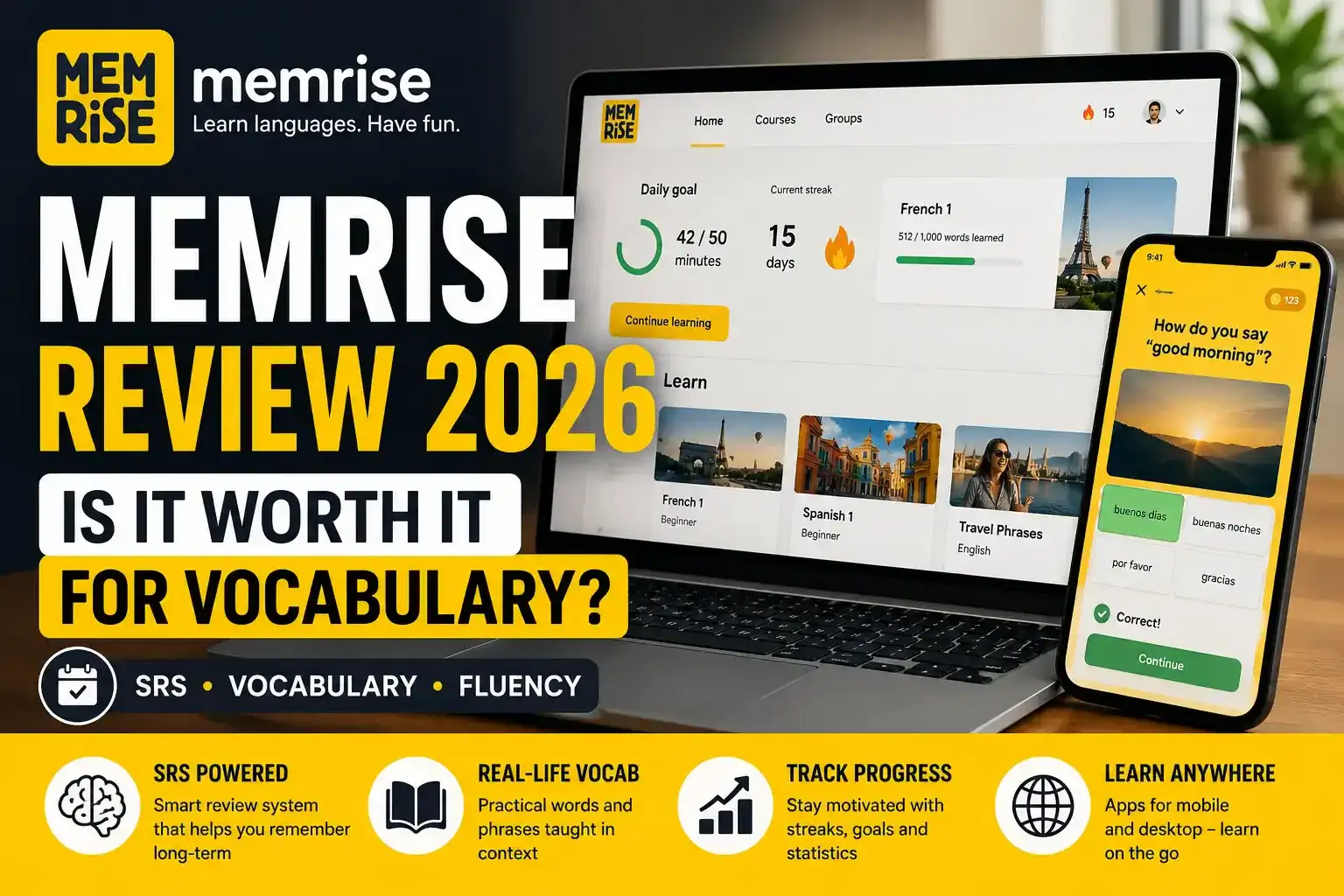
Memrise Review 2026: Is It Worth It for Vocabulary & SRS?
TL;DR
Memrise review in short: Memrise is a vocabulary-first language app built around spaced repetition and native-speaker video. It works well for beginners and intermediate learners who want words to actually stick. It won’t make you fluent on its own, but its SRS engine is one of the more honest implementations in the app market. The free tier is genuinely useful. Pro unlocks offline access, grammar tools, and AI conversation practice.
A 2025 peer-reviewed study on EFL learners (English as a Foreign Language) found that 90% of participants increased their vocabulary performance on post-test scores after using Memrise — results attributed directly to spaced repetition and contextualised learning. That is a meaningful result. But a controlled study on 30 high school students is not the same as you standing at an Italian station, trying to remember the word for ‘binario’ (platform).
The honest question is whether Memrise actually delivers that kind of retention in everyday use — and whether it is worth your time and money in 2026.
I track AI-powered language learning tools and their real-world effectiveness. This Memrise review covers what the tool actually is, how its SRS system works, where it falls short, how it compares to Duolingo and Babbel, what you pay, and who it is genuinely built for.
What Is Memrise and How Does It Work?
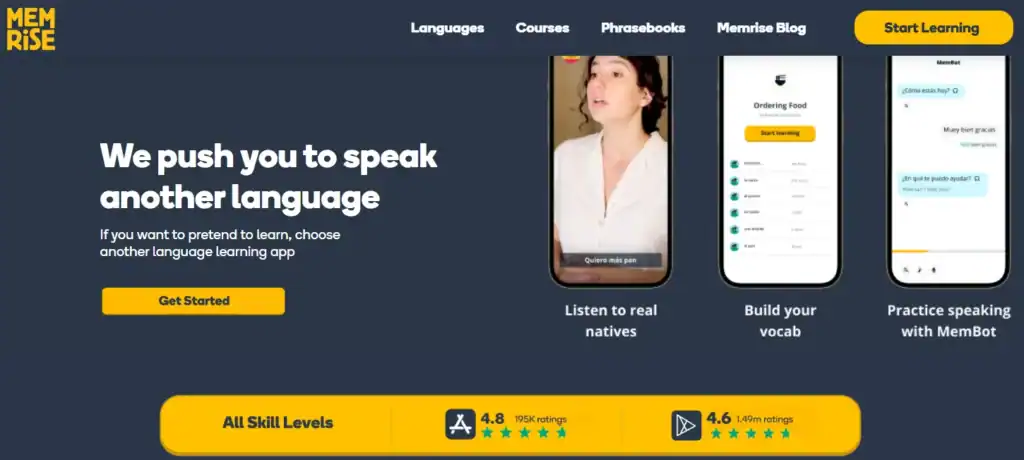
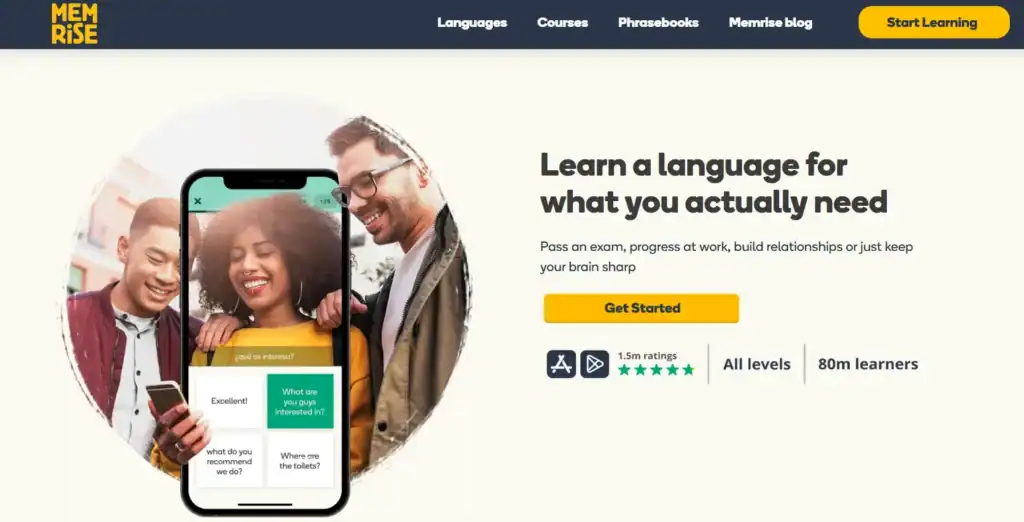
Memrise is a language learning app built around one core idea: vocabulary retention through spaced repetition. It covers 20+ official languages and uses a “Learn, Immerse, Communicate” model. You learn new words, see them used by native speakers in short video clips, then practise through an AI chatbot called Grammarbot.
The brand name is intentional. Memrise is built around memory science, not gamification for its own sake. Where Duolingo’s design is built around streaks and social pressure, Memrise is built around the forgetting curve, the idea that your brain drops new information at a predictable rate unless it is reviewed at the right moment.
The result is an app that feels less like a game and more like a well-organised study partner. The lessons are short, the interface is clean, and the feedback loop is tight.
How Memrise Uses Spaced Repetition (SRS)
Spaced repetition is the engine underneath everything Memrise does. When you learn a new word, the app tracks how confidently you recalled it and schedules your next review accordingly. Words you find easy get pushed further out. Words you keep missing get surfaced again quickly.
This is not a marketing claim. A 2025 cohort study published in Academic Medicine (PubMed) confirmed that spaced repetition is superior to repeated study for both long-term retention and knowledge transfer. The mechanism works because it forces active recall at the moment your memory is about to fade — which is the most efficient point to reinforce learning.
In practice, inside the app, this means your review queue is always a mixed bag. You will see words you learned yesterday sitting next to ones from three weeks ago that you keep getting wrong. That mix can feel slightly random if you do not know why it is happening. Once you understand the SRS logic, it stops feeling arbitrary and starts feeling precise.
The Scenario-Based Learning Structure
Memrise restructured its course format in 2024, moving from a level-based system (Spanish 1 through 7) to a single course per language broken into Scenarios. Each Scenario has two phases: Learn and Review.
The exercise types are varied enough to keep sessions from feeling repetitive: multiple choice, speed sounds, fill-in-the-blank, listening drills, and sentence writing. One thing I noticed immediately when working through the Italian course is that the app locks the next Scenario until you complete the current one. This is not optional — the progression is sequential. For some learners that structure is reassuring. For others who want to jump around, it is mildly frustrating.
A quick note on the 2024 platform changes: Memrise moved all user-generated community courses off the main app in March 2024, relocating them to a separate site (community-courses.memrise.com). The main app now runs exclusively on official Memrise courses. This was a significant shift for long-time users, but for anyone coming to Memrise fresh in 2026, the current platform is clean, focused, and well-maintained.
Is Memrise Effective for Language Learning?
Yes, for vocabulary acquisition — with a clear ceiling. Memrise is built around the right mechanism: spaced repetition forces active recall at the exact moment your memory is about to drop a word, which is why the retention gains are real and measurable. The ceiling is just as important to understand. Memrise does not teach grammar systematically, and even the Pro Grammarbot is a supplement rather than a structured course. If your goal is conversational fluency, Memrise alone will not get you there.
That effectiveness is backed by research. The 2025 study as mentioned earlier showed 90% of participants increased their vocabulary performance on post-test scores after using Memrise.
Key takeaway:
Memrise is excellent at making vocabulary stick. It is not a complete language learning solution on its own. Pair it with a grammar resource and speaking practice.
My Experience Tracking Retention Over Time
As someone who tracks language learning tools and their real-world effectiveness, I run Memrise sessions alongside other SRS tools to compare retention outcomes. What stands out is the consistency of the review algorithm. After three weeks of daily 10-minute sessions in Italian, the words Memrise flagged as “difficult” were genuinely the ones I kept blanking on in real conversation. The algorithm read my recall patterns accurately.
What it did not do was help me string those words into sentences. I could recall ‘binario’ and ‘coincidenza’ reliably. Using them naturally in conversation required something else entirely. That gap is real and worth planning for.
If you want to understand the memory science behind why SRS outperforms traditional review, how spaced repetition builds vocabulary faster than rereading goes deeper into the research before you set up your first session.
How Fluent Can You Get with Memrise?
Memrise can realistically build you to A2-B1 vocabulary level in a supported language, assuming consistent daily use over several months. It will not take you to B2 or beyond on its own.
B1 means you can understand the main points of clear, standard speech and handle most travel situations. B2 means you can converse fluently enough that interaction with native speakers is comfortable without strain. Memrise closes in on B1 vocabulary. The B2 gap requires grammar depth and speaking output that the app does not provide.
For learners who want to push further, pairing Memrise with a dedicated conversation platform — such as Talkio for AI-driven speaking practice — covers the output gap that Memrise leaves open.
Memrise vs Duolingo: Which Is Better for Vocabulary?
For vocabulary retention, Memrise wins. For building a daily habit and covering grammar basics, Duolingo wins. These are not the same goal, which is why the comparison depends entirely on what you are trying to do.
In my experience tracking both platforms, Duolingo is engineered for consistency — the streaks, the notifications, the social leaderboards all exist to get you to open the app every day. Memrise is engineered for retention — the SRS algorithm exists to make sure that when you do open the app, what you study actually stays. One optimises for behaviour, the other for memory. Most learners who come to Memrise have already tried Duolingo and noticed that words are not sticking. That is not a Duolingo failure exactly — it is a sign they have outgrown what Duolingo is designed to do.
Feature |
|
|
|---|---|---|
SRS system | Yes, vocabulary-focused | Partial, sentence-based |
Native speaker video | Yes | No |
Grammar instruction | Minimal (Grammarbot, Pro only) | Implicit, through repetition |
Free tier quality | Strong core access | Very generous |
Fluency ceiling | A2-B1 vocabulary | A2-B1 general |
Best for | Vocabulary retention | Habit building |

If pure SRS power is what you are after, how Anki and MosaLingua compare for serious vocabulary learners puts two of the most dedicated flashcard tools head to head.
Memrise vs Babbel: A Different Kind of Competitor
Babbel is grammar-led and conversation-focused. Memrise is memory-led and vocabulary-focused. At similar annual price points, these two apps are better understood as serving different stages of the learning journey than as direct substitutes for each other.
Babbel lessons are built by linguists and structured to move you from beginner sentences toward functional conversation. If grammar and speaking output are your priority, Babbel is the stronger tool. If you need words to stick first, before grammar even makes sense, Memrise is where you start. Many serious learners use both, in that order.
Feature |
|
|
|---|---|---|
Teaching method | SRS + video immersion | Structured grammar-first |
Grammar coverage | Limited | Strong |
Native speaker video | Yes | Partial |
Price (annual) | ~$80/yr | ~$84/yr |
Best for | Vocabulary & listening | Grammar & conversation |
On price, both apps are comparable at the annual tier. If budget is the deciding factor, the free tier on Memrise offers meaningfully more core content than Babbel’s free version, which is essentially a demo.
How Much Does Memrise Cost in 2026?
Memrise runs a freemium model. The free plan is genuinely functional — not just a trial. You get access to official courses across all supported languages, core SRS review, and native speaker clips. What you do not get: offline mode, Grammarbot, full video libraries, grammar drills, or ad-free browsing.
The Pro plan unlocks everything. One subscription covers all 20+ languages on a single account — relevant if you are studying more than one language simultaneously.
Plan | Cost | Best For |
|---|---|---|
Free | $0 | Casual learners, testing the app |
Pro Monthly | $39.99/mo | Short-term or trial users |
Pro Annual | $79.99/yr (yr 1), $99.99 renewal | Committed learners — best value |
Lifetime | $329.99 one-time | Long-term polyglots |
One honest caveat on pricing: user reviews on third-party platforms flag auto-renewal as a friction point. Memrise does not send reminders before charging the annual renewal. If you sign up for a year and forget, the charge lands without warning. Set a calendar reminder at the 11-month mark if you are not certain you want to continue.
The 30-day money-back guarantee on annual plans is genuine — worth knowing if you want to test Pro properly before committing.
Who Is Memrise Best For?
Memrise is not a one-size-fits-all app. Here is a clear breakdown of who gets the most out of it and who would be better served elsewhere.
Memrise works well for:
- Beginners building vocabulary fast. The onboarding is smooth, the Scenarios are well-paced, and the SRS algorithm handles the scheduling work for you.
- Intermediate learners supplementing grammar study. If you are studying grammar elsewhere and need a vocabulary engine running in parallel, Memrise fits that role cleanly.
- Exam preppers (IELTS, TOEFL, DELF). Vocabulary acquisition is a measurable component of all major language exams. Memrise’s SRS system is built exactly for this kind of targeted word memorisation.
- Duolingo users who want better retention. If Duolingo is not making words stick, Memrise’s memory-science approach is a natural next step.
- Polyglots studying multiple languages. One Pro subscription covers all languages. That is strong value if you are running two or three languages simultaneously.
Memrise is not the right fit for:
- Advanced learners (B2+). The content does not go deep enough in most languages for advanced study. You will hit the ceiling quickly.
- Learners who need grammar depth. Grammarbot is helpful but not a substitute for a structured grammar course.
- Anyone expecting conversational fluency from a single app. No app delivers that. Memrise is a vocabulary engine, not a complete language solution.
For a full comparison of where Memrise sits against other memory-focused tools, the best vocabulary learning apps ranked by SRS quality covers the wider field.
Worth Reading Next:
- Best Spaced Repetition Software to Master Vocabulary
- Best Vocabulary Learning Apps (SRS & Memory-Focused)
- Spaced Repetition vs Traditional Learning: Which Works?
Memrise Review: Final Verdict
The verdict of this Memrise review is straightforward Memrise is a reliable vocabulary engine with an honest SRS implementation. It does what it says: it makes words stick, with memory science doing the scheduling work so you do not have to. The free tier is genuinely functional, the Pro plan is fairly priced at the annual level, and the native-speaker video content adds a layer of real-world context that purely flashcard-based tools lack.
The limitations are just as real. Memrise will not teach you grammar. It will not make you conversationally fluent on its own. The 2024 platform changes removed the community course flexibility that long-term users valued. And the auto-renewal process needs more transparency than it currently has.
The right approach: start with the free plan, run it for two weeks across your target language, and see whether the SRS algorithm surfaces words in a way that matches how your memory actually works. If it does, the annual Pro plan is worth the upgrade. If it does not, you have lost nothing.
Frequently Asked Questions
Is Memrise still free in 2026?
Yes. The free plan gives you access to official courses across all supported languages, core SRS review sessions, and native speaker video clips. You do not need to pay to use the fundamental learning loop. The Pro plan adds offline access, Grammarbot, grammar drills, full video libraries, and an ad-free experience.
Can Memrise replace Duolingo completely?
It depends on what you used Duolingo for. If your primary goal was vocabulary retention, Memrise is a stronger tool. If you relied on Duolingo for grammar exposure and daily habit-building, you will notice the gap. Most learners do better using Memrise as a vocabulary layer alongside a grammar resource, rather than treating it as a complete replacement.
How long should I use Memrise each day?
10 to 15 minutes of focused daily review is enough to keep your SRS queue manageable and make consistent progress. The research on spaced repetition consistently shows that frequency matters more than session length. Shorter, daily sessions outperform longer, irregular ones for long-term retention.
Is Memrise good for exam vocabulary like IELTS or TOEFL?
Yes, it is one of the more practical tools for exam vocabulary preparation. The SRS algorithm is well-suited to the kind of targeted word memorisation that language exams require. You will need to source or build a word list relevant to your specific exam — Memrise’s official courses cover general vocabulary but not always exam-specific word sets. The Pro plan’s Difficult Words mode is particularly useful for drilling the words you keep getting wrong.