Best Language Learning Apps for Beginners
TL;DR
Language learning apps work, but the wrong one wastes your time. Duolingo is free and great for building a daily habit. Babbel has the academic research behind it and teaches real grammar. Memrise suits vocabulary-first learners. Rosetta Stone goes deep on immersion. The right pick depends on your goal, not the download charts.
AI language learning apps are projected to grow at 21.2% CAGR through 2033 — faster than almost any other education technology segment [Source: GM Insights via AI Language Learning Statistics].
Tens of millions of people are downloading these apps every year. Most of them will quit before they can hold a basic conversation. The apps aren’t the problem. Picking the wrong one for how you learn is.
Most beginners default to whatever app has the most reviews. That’s how you end up three months into Duolingo, able to translate “the bear drinks milk” but unable to order a coffee abroad. This post matches you to the right app based on how you actually learn, how much you want to spend, and what you’re trying to do with the language.
The Best Language Learning Apps for Beginners in 2026
Each app below was evaluated on grammar instruction, speaking practice, free tier value, and beginner accessibility
No single app wins for everyone. Here’s who each one is actually built for.
Duolingo – Best for Building a Daily Habit (Free)

Key Features
- 40+ languages including less common options like Welsh, Hawaiian and Navajo
- Streak system and gamified XP rewards designed to drive daily use
- Listening, reading, speaking and writing exercises in every lesson
- Offline mode available on mobile
- AI conversation partner (Lily) available on Duolingo Max plan
- Podcast and Stories content for intermediate learners built into the app
Why You’ll Like It
Duolingo’s streak system is genuinely effective at building the one thing beginners struggle with most: showing up every day. The gamification isn’t just cosmetic — the dopamine loop of maintaining a streak, earning XP and unlocking new levels creates a habit faster than any other app on this list. For a complete beginner who isn’t sure they’ll stick with it, free and habit-forming is exactly the right starting point.
The breadth of languages is also a real advantage. With 40+ options, Duolingo is often the only app available for less common languages. If you’re learning something outside the major European set, it may be your only structured digital option.
Duolingo hit 52.7 million daily active users in Q4 2025 and crossed $1 billion in annual revenue for the first time in FY2025, per CX Dive. Those numbers matter for beginners because they signal an active development roadmap and a large community — both of which translate to better content and faster bug fixes than smaller competitors can manage.
Things to Keep in Mind
Grammar instruction is Duolingo’s consistent weak point. Lessons teach you to pattern-match through repetition rather than understand why a sentence is constructed the way it is. This works up to around A2 level and then creates a ceiling that’s genuinely hard to break through without supplementing elsewhere.
Speaking practice is also shallower than the app’s overall polish suggests. Basic exercises ask you to repeat phrases without real conversational context. The AI conversation partner (Lily) that would address this is locked behind the Duolingo Max plan at around $30/month — a significant jump that puts it above Babbel’s annual rate for a feature that competing apps include as standard.
The Bottom Line
Duolingo is the right starting point if you need free, low-friction and habit-forming. Accept its grammar limits from the start, plan to supplement it with a speaking tool once you have basic vocabulary, and don’t pay for Max unless the AI conversation feature is specifically what you’re after.
Learners who find themselves wanting more speaking practice than Duolingo offers will find that dedicated AI conversation tools deliver significantly more at a lower price point, this comparison of the best AI language tutor apps is the natural next step.
Pricing
- Free (ads, full core content)
- Super Duolingo: ~$8/month
- Duolingo Max (AI features): ~$30/month
👉 If you’ve outgrown Duolingo’s beginner content and want to know how it stacks up for intermediate and advanced learners, see the full breakdown in Best Language Learning Apps for Fluency.
Babbel – Best for Structured Beginners Who Want Real Grammar (Paid)

Key Features
- 14 languages with a focus on major European languages
- Grammar explanations woven directly into lessons — no separate grammar module
- Natural, real-world phrases and dialogues rather than isolated vocabulary drills
- Babbel Speak AI conversation tool included in all plans
- CEFR-aligned curriculum from A1 through B2
- Review Manager that surfaces forgotten vocabulary using spaced repetition
- Lessons designed for 10–15 minutes, completable on mobile or desktop
Why You’ll Like It
Babbel is the only major language learning app with peer-reviewed, independent academic studies confirming its effectiveness — and the results are worth knowing before you spend money on anything else. Researchers at Michigan State University studied 85 students using Babbel for 12 weeks at just 10 minutes per day. Nearly all made statistically significant gains, and 59% improved oral proficiency by at least one sublevel on the ACTFL scale, a credible, standardized speaking assessment.
The full Babbel review goes deeper on pricing, lesson structure, and whether the annual plan or lifetime subscription makes more sense for new learners.
What makes it work for beginners specifically is how grammar is handled. Rather than presenting a grammar table and asking you to memorize it, Babbel weaves short explanations directly into lessons — one or two sentences of context, followed immediately by a drill. You absorb the rule by using it, not by studying it. The phrases you practice are things people actually say, which means the vocabulary sticks because it has real-world relevance from day one.
Babbel Speak, the app’s AI conversation tool, is included in all plans at no extra cost. This is a meaningful practical difference from Duolingo, where equivalent functionality costs an additional $30/month.
Things to Keep in Mind
Babbel only covers 14 languages. If you’re learning anything outside its catalogue — Arabic, Mandarin, Japanese, Korean, most African or Southeast Asian languages — it simply isn’t an option. Check the language list before committing.
There is no meaningful free tier. You can sample a single lesson per language without paying, but that’s it. For learners who want to test before subscribing, the trial is thin compared to Duolingo’s fully free core product.
The CEFR curriculum tops out at B2, so advanced learners will eventually need to move beyond it. For beginners that ceiling is far enough away not to matter, but it’s worth knowing the app’s range upfront.
The Bottom Line
Babbel is the best-researched beginner app on this list and the strongest choice if grammar and real conversational ability are your goal. The academic evidence is genuine, the lesson design is thoughtful, and the included speaking tool removes the biggest gap that holds other structured apps back.
Pricing
- No meaningful free tier (one sample lesson per language)
- ~$13/month (monthly)
- ~$7–8/month (annual plan)
👉 For a direct head-to-head on methodology, content depth and value, see Babbel vs Rosetta Stone.
Memrise – Best for Vocabulary and Real-World Video Content

Key Features
- Native speaker video clips showing real people using the language in everyday situations
- Spaced repetition system built into vocabulary review
- 20+ languages available
- “Learn with Locals” video library for listening comprehension
- Pronunciation comparison tool using your device microphone
- Offline learning available on mobile
Why You’ll Like It
Memrise’s differentiator is a library of short video clips of real native speakers using the language in natural, unscripted contexts — regional accents, hesitations, colloquialisms included. Most apps simulate language. Memrise exposes you to it as it actually sounds from the first session, which builds listening comprehension and realistic pronunciation expectations faster than any animated character can.
For beginners preparing for travel or wanting early exposure to how the language actually sounds in the wild, this is a genuine advantage. The spaced repetition system underneath the vocabulary drills is also solid — words resurface at the right intervals to move them into long-term memory rather than disappearing after one lesson.
Things to Keep in Mind
Memrise is primarily a vocabulary and listening tool. Grammar instruction is minimal — the app teaches you what words mean and how they sound, but not reliably why they fit together the way they do. Used alone, it will build a reasonable passive vocabulary but won’t develop the structural foundation needed for real conversation.
It works best as a complement to a grammar-focused app like Babbel rather than as a standalone starting point for complete beginners.
The Bottom Line
Memrise is the strongest vocabulary and listening tool for beginners on this list. Add it alongside a structured app and you cover two of the biggest gaps in early language learning — grammar from one, authentic listening input from the other.
Pricing
- Free tier available (limited content)
- Pro: ~$8–9/month (annual plan)
👉 If vocabulary retention and spaced repetition are a priority for you, see how dedicated SRS tools compare in Best Vocabulary Learning Apps (SRS & Memory-Focused).
Rosetta Stone – Best for Immersive Learning Without Translation

Key Features
- Full immersion method, all instruction delivered in the target language from lesson one
- 25+ languages available
- Voice recognition engine covering 30 languages at over 93% accuracy (2025)
- Phased Story-based lessons that build vocabulary through context rather than translation
- Live tutoring sessions available as an add-on, though availability varies by region and account type
- Lifetime purchase option available, currently only on the EU site, not the US site
- Offline access on mobile
Why You’ll Like It
Rosetta Stone’s method is genuinely different from every other app on this list. There are no translations, no English explanations, no bilingual glossary. You associate words and phrases directly with images, sounds and context — the way children acquire language, rather than the way most adults were taught in school. For learners who find constant translation back to their native language a crutch rather than a help, this is the right design philosophy.
The voice recognition is among the best available in a consumer app, covering 30 languages at over 93% accuracy as of 2025, according to industry data. Pronunciation feedback is immediate and granular, which matters for beginners before bad habits set in.
Things to Keep in Mind
The immersion approach can feel disorienting for absolute beginners who want explicit grammar instruction first. The first few hours of Rosetta Stone involve a lot of educated guessing — you’re inferring meaning from images without any scaffolding. Most learners push through it and the method clicks, but it demands more patience at the start than any other app here.
It is also the most expensive option on this list on a monthly basis, and the lack of grammar explanation means some learners plateau without understanding why certain constructions work the way they do.
The Bottom Line
Rosetta Stone suits a specific kind of beginner: one who is motivated, patient, and actively wants to avoid the translation habit. If that’s you, the immersion method and voice recognition make it a strong long-term investment. If you want to understand grammar rules explicitly before using them, start with Babbel instead. For a closer look at the immersion method, current pricing, and tutoring add-on, the full Rosetta Stone review covers what’s changed in 2026.
Pricing
- No free tier
- ~$13,25/month (annual plan)
- EU: lifetime access available for €199 (periodically discounted), plus subscription tiers from ~€10.95/month
👉 For a full methodology and value comparison between these two, see Babbel vs Rosetta Stone.
Busuu – Best for Beginners Who Want Human Feedback

Key Features
- Native speaker community review of your written and spoken exercises
- CEFR-aligned structured courses from A1 to B2
- 14 languages available
- Grammar Booster module with explicit grammar instruction
- Offline lessons available on mobile
- Study plan tool with progress tracking and goal setting
- Official certificates of completion aligned to CEFR levels
Why You’ll Like It
Busuu’s community feedback feature is what sets it apart from every other app on this list. Submit a written or spoken exercise and native speakers review and correct it — not automated feedback, actual human input on what you got wrong and why. For beginners who want more than a green checkmark confirming their answer was correct, this is a meaningful step up.
After integrating live tutor functionality, Busuu reported a 27% improvement in course completion rates, according to 2025 market data. That tracks with what the research says about accountability: human feedback, even occasional and asynchronous, significantly improves follow-through compared to fully automated learning.
The Grammar Booster module is also genuinely useful for beginners who want explicit instruction rather than inferring rules from drills — it sits alongside the main course rather than being woven in, so you can engage with it on your own terms.
Things to Keep in Mind
The community feedback feature — the main reason to choose Busuu over other options — is locked behind the premium plan. The free tier is functional for basic lessons but doesn’t include the human correction element, which removes the app’s primary differentiator.
Language coverage is limited to 14, the same as Babbel, so the same caveat applies: check the list before committing if you’re learning something outside the major European set.
The Bottom Line
Busuu is the right choice for beginners who know they need external accountability to stay consistent, and who want human feedback on their output rather than purely automated correction. The community feature is genuinely useful and the CEFR-aligned curriculum gives structure that casual apps lack.
Pricing
- Free tier (limited, no community feedback)
- Premium: ~$10/month (annual plan)
👉 For how Busuu compares to other structured apps at intermediate level, see Best Language Learning Apps for Fluency.
Talkio AI – Best for Speaking Practice from Day One
Key Features
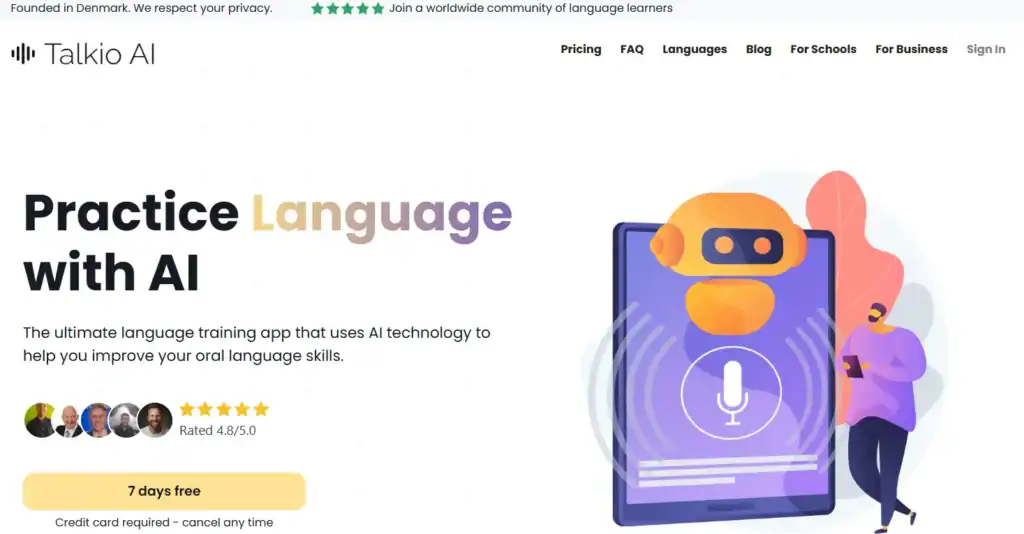
- 400+ AI tutors across 70+ languages and 134 dialects
- Real-time pronunciation feedback with word-by-word correction
- Role-play scenarios covering everyday situations (ordering food, asking directions, job interviews)
- Crosstalk mode: speak your native language, AI responds in your target language
- Conversation history and progress tracking across sessions
- Grammar correction integrated into conversation flow rather than as separate exercises
- 7-day free trial, no credit card required
Why You’ll Like It
Every other app on this list treats speaking as something you work up to. Talkio treats it as the starting point. From your first session you are having a conversation — simplified, supported and corrected in real time, but a real conversation nonetheless. For beginners who know that speaking anxiety is going to be their biggest obstacle, this is the most direct solution available.
The crosstalk mode deserves specific mention for absolute beginners. You speak in your native language; the AI responds in your target language. You’re exposed to the target language from session one without the pressure of producing it correctly. It’s a genuine on-ramp that no other app on this list offers.
A 2025 study found that students using AI speaking practice apps showed a 75% improvement in overall speaking scores over 8 weeks of consistent use, [Source: Thao, Ly, Thu & Kien (2025), “AI-Assisted Speaking Practice: An 8-Week Study”]. The breadth of language coverage — 70+ languages and 134 dialects — also means Talkio works for learners studying languages that Babbel and Busuu don’t cover.
Unlike Duolingo’s AI conversation tool, which costs around $30/month as a standalone add-on, Talkio’s full feature set starts at $7/month on an annual plan with a 7-day free trial.
Things to Keep in Mind
Talkio is a speaking tool, not a full curriculum. It does not teach grammar systematically, build reading skills or provide structured vocabulary progression. Used alone as a beginner’s only resource, it would develop your speaking confidence without giving you the structural foundation to know what you’re actually saying.
It works best as a complement to a structured app — Babbel being the natural pairing — rather than as a replacement for one.
The Bottom Line
Talkio is the most effective speaking practice tool for beginners on this list and fills the gap that every other app here leaves open. If speaking the language is your end goal — and for most people it is — adding Talkio to a structured app like Babbel gives you a combination that covers grammar, vocabulary and real conversation from the start.
Pricing
- 7-day free trial (no credit card required)
- ~$7/month (annual plan)
- ~$13/month (quarterly plan)
👉 If you want a human tutor rather than an AI conversation partner, Best Language Learning Platforms with Tutors covers Preply, iTalki and other tutoring platforms in detail.
Side-by-Side Comparison Table
App | Best For | Free Tier | Starting Price | Languages | Grammar Focus | Speaking Practice | AI Features |
|---|---|---|---|---|---|---|---|
Duolingo | Daily habit, casual learning | Yes (full) | ~$8/month | 40+ | Minimal | Basic | AI chat locked at $30/mo |
Babbel | Structured grammar, real conversations | No | ~$7/month (annual) | 14 | Strong | Good (Babbel Speak included) | AI speech recognition |
Memrise | Vocabulary, native video content | Yes (limited) | ~$8/month | 20+ | Basic | Moderate | Native speaker clips |
Rosetta Stone | Immersive learning, no translation | No | ~$13,25/month. Lifetime €199 (EU) | 25+ | Implicit | Strong (voice recognition) | 93% accuracy voice engine |
Busuu | Human feedback, accountability | Yes (limited) | ~$10/month | 14 | Strong | Moderate + native corrections | Community review |
Talkio | Speaking practice from day one | 7-day trial | ~$7/month (annual) | 70+ / 134 dialects | None (speaking only) | Excellent | 400+ AI tutors, real-time feedback |
Which App Should You Actually Start With?
The decision comes down to one question: what is going to keep you practicing tomorrow?
The most effective language learning app
is the one you will actually open every day.
Pick based on your habit style first, your learning style second.
- You’re a complete beginner with no budget: Start with Duolingo. Use it to build the habit. Accept its limits.
- You’re serious and can spend $7–8/month: Start with Babbel. The grammar foundation will serve you for years.
- You want to hear real people speaking from day one: Add Memrise alongside whichever app you choose for structure.
- You hate translating back to English: Rosetta Stone is built for you specifically.
- You want human feedback on your writing and speaking: Busuu’s community feature is worth the premium price.
- You’re terrified of speaking but know you need it: Talkio removes that fear faster than any other tool on this list.
Most learners who reach conversational level use two apps: one for structured learning (Babbel or Duolingo) and one for speaking practice (Talkio). The combination covers what no single app does on its own.
Can You Actually Get Fluent With a Language App?
No app alone will get you to fluency — but the right app builds the foundation that makes fluency possible. This distinction matters because it affects how you set expectations and plan your learning.
The MSU Babbel study showed meaningful oral proficiency gains in 12 weeks at 10 minutes per day. That is a real result — but it measures beginner-to-intermediate gains, not fluency.
As UW-La Crosse Spanish professor Kimberly Morris put it after reviewing the current research: “there is no shortcut to language learning.” Apps excel at building habit, vocabulary, and structural foundation. They fall short on authentic conversation, cultural nuance, and the kind of pressure-tested speaking ability that only comes from real interaction.
The practical takeaway: use an app to build your base, then add speaking practice (Talkio, an online language tutor, or a language exchange) once you can hold a simple conversation. That’s the path most successful self-studiers actually follow.
Conclusion
The best language learning app for beginners is the one that matches how you learn, not which one has the most downloads. Start with one app for structure — Babbel if you’re serious about grammar, Duolingo if you need free and habit-forming — and add a speaking tool like Talkio once you have the basics. That combination covers more ground than any single app on its own.
For a deeper look at how these tools fit into a full learning system, the Ultimate Guide to Language Learning Technology is the logical next step. Ready to put these tools into a structured routine? The AI Language Learning Plan: A Step-by-Step Guide shows you exactly how to combine them into a system that builds toward fluency.
Frequently Asked Questions
Is Duolingo good enough to learn a language from scratch?
Duolingo is good enough to start from scratch and build basic vocabulary and listening skills — but its grammar instruction is too thin to take you beyond an A2 level on its own. Most learners who get to conversational ability with Duolingo supplement it with a grammar-focused resource or speaking practice tool.
Is Babbel worth paying for when Duolingo is free?
For beginners who want more than habit-building, yes. Babbel’s grammar instruction, natural phrase library, and included speaking practice (Babbel Speak) produce better structural foundations than Duolingo’s free tier. At ~$7/month on an annual plan, the cost is modest relative to the research-backed results.
Which language learning app is best for older adult beginners?
Babbel skews toward adult learners — the Yale study on Babbel included participants aged 55 and over, with 52% of participants over 55 making gains comparable to younger cohorts. Its clean interface and explicit grammar instruction suit learners who prefer structured, text-based learning over gamified systems.
What can the CIA and FBI method teach beginners about learning a language?
Government language programs like the Defense Language Institute combine daily immersive instruction, explicit grammar from day one, and constant low-stakes speaking practice. No app replicates that volume, but beginners can borrow the core logic: 10–15 minutes of daily contact beats weekly cramming, speaking early reduces anxiety later, and grammar and vocabulary must grow together.
What is the 15/30/15 method for language learning?
The 15/30/15 method structures a daily practice session into three blocks: 15 minutes of input (reading or listening), 30 minutes of speaking output, and 15 minutes of review. It mirrors the output-heavy approach used in government language training and works well for beginners using a combination of apps — Babbel for the input and review blocks, Talkio for the speaking block.
Can I use more than one language learning app at the same time?
Yes, and for most learners it is the better approach. Using a structured app (Babbel or Duolingo) for grammar and vocabulary alongside a speaking tool (Talkio) covers the two areas where single apps consistently fall short. Avoid using two structural apps simultaneously — that creates overlap without benefit.