Best Vocabulary Learning Apps (SRS & Memory-Focused)
TL;DR
The best vocabulary learning app for most learners is Memrise, it combines spaced repetition with native speaker video and a beginner-friendly interface that makes daily practice easy to stick with. For a structured, audio-focused alternative with no setup required, MosaLingua is worth considering, its frequency-based word lists and built-in review scheduling make it a strong option for beginners who want to start immediately. For serious learners who want maximum retention control, Anki remains the benchmark. If you just want something visual and low-commitment to start with, Drops is the easiest entry point. If you have already covered the basics and want to push past the beginner vocabulary ceiling, Clozemaster is the purpose-built tool for intermediate learners.
The best vocabulary learning apps use spaced repetition and active recall to build long-term memory on mobile. Tools like Anki, Memrise, MosaLingua, Clozemaster, Quizlet, and Drops help learners retain words more efficiently and they’re designed to fit into your day, not around it. Each app serves a different learning style and stage. The right choice depends on whether you prefer structure, flexibility, visual engagement, or high-volume intermediate drilling.
If you’re a more advanced learner looking for desktop-based power tools with deep algorithmic control, our guide to the best spaced repetition software covers that ground instead.
Why vocabulary apps matter for language learning
Vocabulary is the foundation of comprehension and communication.
Without enough words, grammar knowledge has limited practical value. You may understand rules but struggle to express ideas clearly. Vocabulary depth directly influences listening, speaking, reading, and writing ability.
Memory research shows that forgetting is natural without review. The brain removes unused information quickly. Structured repetition slows this process and improves recall.
Vocabulary apps solve a critical problem: they make review systematic instead of random and they do it in the palm of your hand.
For learners who want to go further, AI-enhanced vocabulary practice takes that systematic approach and adapts it to your individual performance in real time.
The numbers actually back this up too, the statistics on AI-powered language tools show that adaptive platforms are reporting up to 30% better outcomes compared to fixed-curriculum approaches, which is a meaningful gap when you’re investing real time in learning.
Best vocabulary learning apps in 2026
Anki
Anki is built for learners who care about long-term memory and full control. It is not flashy, but it is extremely powerful. If vocabulary retention is your priority, Anki remains one of the most effective tools available, on mobile or desktop.
Key Features
- Advanced spaced repetition algorithm
- Fully customizable flashcards
- Large shared deck library
- Available on desktop and mobile
- Supports audio, images, and example sentences
Why You’ll Like It
Anki shows cards just before you are likely to forget them. This timing strengthens memory and reduces wasted review time. You can tailor decks exactly to your needs, whether for exams, travel, or daily conversation. Serious learners appreciate the flexibility and precision.
Things to Keep in Mind
The interface feels dated compared to modern apps. Initial setup requires effort. There is no built-in course structure unless you import decks. Anki rewards consistency and patience.
The Bottom Line
Anki is a memory optimization tool, not a guided learning platform.
Best For
Learners focused on deep retention, exam preparation, and large vocabulary goals.
Pricing
Free on desktop. Paid mobile app on iOS. Free or low-cost options on Android.
Memrise

Memrise balances structured learning with strong memory principles. It combines spaced repetition with multimedia content and guided courses. The experience feels polished and beginner-friendly.
Key Features
- Spaced repetition review system
- Built-in vocabulary courses
- Native speaker video clips
- Pronunciation support
- Clean, intuitive interface
Why You’ll Like It
Memrise makes vocabulary learning feel approachable. The design reduces friction and encourages daily use. Video examples help connect words with real pronunciation and context. It feels like a structured system without being overwhelming.
Things to Keep in Mind
Customization is more limited than Anki. Community-created courses were removed from the main app in 2024 and now live on a separate site, significantly reducing content variety. Some advanced features require a subscription. Course depth varies by language. Memrise favors usability over total control.
The Bottom Line
Memrise is ideal if you want science-backed learning with minimal setup. My full Memrise review covers whether it actually delivers on that promise.
Best For
Learners who want structured guidance and an engaging interface.
Pricing
Free tier available. Premium subscription unlocks full features.
MosaLingua

MosaLingua is a guided vocabulary learning system built around frequency, it prioritises the words you are most likely to actually use in conversation. Pre-curated word lists, native pronunciation audio, example sentences, and automatic SRS scheduling are all built in from the start. There is no deck building or setup required. The app also includes MosaChat, an AI conversation tutor for speaking practice. MosaLingua is subscription-based with a free 7-day trial.
Key Features
- Frequency-based curated word lists
- Native speaker audio and example sentences
- Built-in spaced repetition scheduling
- MosaChat AI conversation tutor
- Offline access
- Available on iOS, Android, and web
Why You’ll Like It
MosaLingua removes the friction that stops most learners from getting started. Because the word lists are pre-built around frequency, you learn high-value vocabulary from session one without having to research what to study. The clean, mobile-first interface makes daily review feel routine rather than effortful.
Things to Keep in Mind
Customisation is limited compared to Anki. Learners who want to build their own decks or study highly specific vocabulary will find MosaLingua too rigid. Better suited as a core vocabulary tool than an advanced supplement.
The Bottom Line
MosaLingua is one of the most frictionless ways to build a solid vocabulary foundation, particularly for beginners who want structure without complexity.
Best For
Beginners and intermediate learners who want a structured, audio-focused vocabulary system with no setup required.
Pricing
Free 7-day trial. Subscription required for full access.
Quizlet
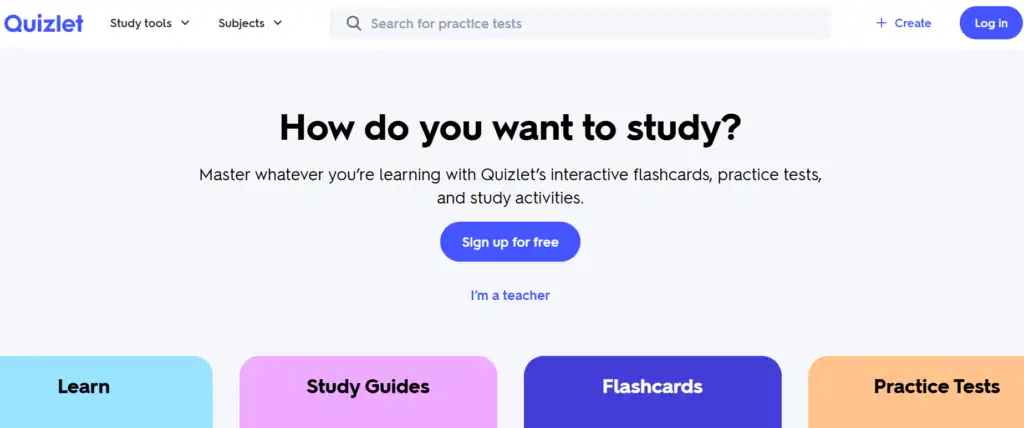
Quizlet is designed for simplicity and fast study sessions. It works well for learners who want flexible vocabulary review without complexity and the massive library of pre-made decks means you can start reviewing immediately.
Key Features
- Flashcards and study sets
- Learn mode and practice tests
- Gamified study options
- Massive user-generated library
- Cross-device sync
Why You’ll Like It
Quizlet is easy to start and easy to use. Creating decks takes minutes. The interface is clean and accessible. Study modes provide variety without confusion. It fits casual and academic learners alike.
Things to Keep in Mind
Spaced repetition is less advanced than Anki. Many exercises emphasize recognition rather than recall. Learning depth depends on deck quality. Quizlet prioritizes convenience.
The Bottom Line
Quizlet is a flexible study companion rather than a retention-maximizing system.
Best For
Casual learners, classroom support, and quick vocabulary review.
Pricing
Free version available. Quizlet Plus unlocks additional features.
Drops

Drops focuses on visual vocabulary learning through short daily sessions. The design is colorful, minimal, and highly engaging. It encourages consistency through time-limited practice making it one of the most approachable options for complete beginners.
Key Features
- Visual word associations
- Gamified exercises
- Five-minute daily sessions (free tier)
- Wide language selection
- Clean, modern design
Why You’ll Like It
Drops feels light and motivating. Sessions are short and easy to maintain. Visual interactions help learners who prefer imagery over text-heavy study. It is especially appealing for beginners.
Things to Keep in Mind
Recall depth is lighter than Anki or Memrise. Speaking practice is limited. Progression may feel slow for advanced learners. Drops emphasizes engagement and habit-building.
The Bottom Line
Drops is excellent for exposure and reinforcement, but not a standalone mastery tool.
Best For
Visual learners, beginners, and habit-focused study.
Pricing
Free tier with daily limits. Premium subscription removes restrictions.
Clozemaster
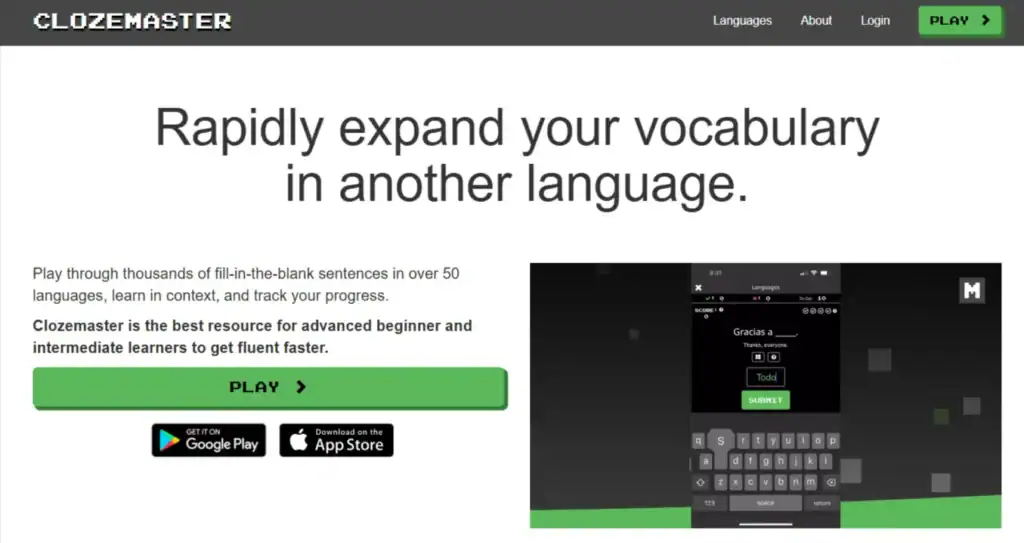
Clozemaster is the vocabulary tool built specifically for the intermediate plateau, the point where Duolingo and Memrise run out of new words to teach. It uses fill-in-the-blank sentence exercises (cloze tests) combined with spaced repetition to drill vocabulary in context at scale.
Key Features
- Context-based fill-in-the-blank (cloze) exercises
- Adaptive spaced repetition that skips what you already know
- 50,000+ sentences organised by word frequency across 66 languages
- Cloze Listening and Grammar Challenges (Pro)
- Available on web, iOS, and Android
Why You’ll Like It
Clozemaster solves the problem that beginner apps never address: vocabulary depth past 2,000 words. Because every word appears in a full sentence rather than an isolated flashcard, you learn which meaning applies in context and not just that a word exists. The SRS is genuinely adaptive. Gamification (streaks, leaderboards, points) creates real pull without being intrusive. See also my detailed review of the platform.
Things to Keep in Mind
Not suitable for absolute beginners, you need basic grammar and vocabulary before the exercises make sense. The interface has a retro aesthetic that can feel cluttered on first use. Sentence quality varies because content is sourced from Tatoeba, a community database. Speaking recognition is unreliable and best treated as a bonus feature.
The Bottom Line
Clozemaster is the most effective tool for expanding vocabulary past the beginner ceiling and its free tier alone makes it worth trying for any intermediate learner.
Best For
Intermediate learners (A2–B2) who have outgrown Duolingo or Memrise and want to build vocabulary at scale.
Pricing
Free tier with 30 sentences per day. Pro subscription removes restrictions.
Comparison of the best vocabulary learning apps
Choosing among the best vocabulary learning apps becomes easier when you compare learning style, retention mechanics, and practical strengths. The table below highlights the differences that matter most for daily study and memory building.
APP | Learning Style | Spaced Repetition | Recall Focus | Customization | Best For |
|---|---|---|---|---|---|
| Structured / Retention-Driven | Advanced | Strong | High | Long-term vocabulary mastery |
| Hybrid (Structured + Gamified) | Yes | Moderate | Medium | Guided vocabulary growth |
| Structured / Audio-Focused | Yes | Strong | Low | Structured vocabulary for beginners |
| Flexible / Study-Friendly | Basic | Mixed | Medium | Casual study & review |
| Gamified / Visual | Limited | Light | Low | Exposure & habit building |
| Context-Driven / Intermediate | Adaptive | Strong | Medium | Intermediate vocabulary at scale (A2–B2) |




Gamified vs structured vocabulary apps
Gamified vocabulary apps prioritize engagement, while structured apps prioritize long-term retention.
Gamified apps use visuals, streaks, points, and short sessions to make learning feel effortless. They reduce friction and help learners stay consistent. This design works especially well for beginners and motivation-driven learners.
Structured apps focus on memory mechanics. They emphasize active recall, spaced repetition, and review timing. These tools often feel less playful but deliver stronger long-term retention when used consistently.
Neither approach is universally better.
Gamified apps help learners who struggle with habit formation. Structured apps help learners who want maximum retention efficiency. Many learners benefit from combining both styles.
How we selected the best vocabulary apps
We evaluated apps based on methodology, usability, and learning focus.
Selection criteria included:
- Use of spaced repetition
- Emphasis on recall vs recognition
- Interface clarity
- Customization options
- Suitability for long-term learning
This list prioritizes memory effectiveness, not entertainment alone.
Apps differ in design philosophy. Some optimize retention. Others emphasize engagement or accessibility. Ranking reflects learning efficiency rather than popularity.
How vocabulary retention actually works
Vocabulary sticks when exposure, recall, and spacing work together.
Like mentioned earlier in this post, the brain removes unused information quickly. Reviewing information at expanding intervals helps move knowledge into durable memory.
Equally important is active recall.
Recognition creates familiarity. Recall builds retrieval strength. Strong retrieval predicts better speaking performance.
Effective vocabulary learning requires:
- Repeated encounters
- Timed review
- Forced retrieval
- Contextual usage
Good apps automate this cycle.
How to choose the right vocabulary app
The best app matches your learning style and consistency level.
Choose Anki if you:
- Care about long-term retention
- Prefer full control
- Study seriously and regularly
Choose Memrise if you:
- Want structured guidance
- Prefer a polished interface
- Enjoy multimedia learning
Choose MosaLingua if you:
- Want to start immediately with no setup
- Prefer a structured, audio-focused experience
- Are a beginner or intermediate learner focused on high-frequency vocabulary
- Want offline access and a clean daily review routine
Choose Quizlet if you:
- Need simplicity
- Study casually
- Use pre-made decks
Choose Drops if you:
- Like visual learning
- Need motivation support
- Prefer short sessions
Choose Clozemaster if you:
- Have already done 3–6 months of Duolingo or Memrise
- Want to rapidly expand vocabulary past the 2,000-word ceiling
- Prefer learning words in full sentence context rather than isolated flashcards
Remember, consistency matters more than app choice.
What is the fastest way to improve vocabulary
Daily recall and spaced review produce the fastest sustainable gains.
Cramming creates short-term familiarity but rapid forgetting. Smaller daily word intake combined with structured review improves stability.
Practical strategy:
- Learn 5–15 new words daily
- Review using spaced repetition
- Use words in sentences
- Speak or write actively
Steady repetition beats intensity spikes. For a deeper look at how spaced repetition stacks up against traditional learning methods and a 30-day system for combining both, spaced repetition vs traditional language learning covers the full comparison.
Common vocabulary learning mistakes
Most vocabulary problems come from weak review habits.
Frequent mistakes include:
- Memorizing isolated word lists
- Ignoring pronunciation
- Overrelying on recognition
- Skipping reviews
- Learning rare words too early
High-frequency vocabulary delivers faster communicative payoff.
A few more useful guides:
- How Spaced Repetition Works for Building Vocabulary Fast
- Anki vs Memrise vs MosaLingua: Which SRS App Helps You Learn Faster? a head-to-head look at three of the most popular spaced-repetition apps, including a direct Memrise vs MosaLingua breakdown for anyone choosing between just those two.

Final thoughts
Vocabulary apps are memory accelerators, not complete language systems. They work best when paired with listening practice, speaking opportunities, reading exposure, and grammar study. Used correctly, they significantly reduce forgetting and improve recall speed.
Learners who want deeper scheduling control, desktop-first workflows, or tools built for researchers and knowledge workers should look at dedicated spaced repetition software instead we cover the best options in a separate guide as mentioned in the beginning.
Frequently Asked Questions
Do vocabulary apps actually improve long-term memory?
Yes — when they use spaced repetition and active recall. Apps that schedule reviews at expanding intervals align with how memory consolidation works. Passive flashcards without structured timing produce weaker retention. Research shows spaced repetition can improve vocabulary retention rates by up to 200% compared to massed practice.
Is Anki better than Memrise for vocabulary?
It depends on what you value. Anki gives you more control and is more effective for serious long-term retention, but it requires setup and patience. Memrise is easier to use immediately and keeps learners more motivated through multimedia and guided courses. Most beginners do better starting with Memrise and graduating to Anki — or Clozemaster — when they want more control or need to push past the beginner vocabulary ceiling.
What causes vocabulary gaps when speaking?
Speaking gaps usually result from recognition-only learning. Knowing a word when you see it does not guarantee retrieval during conversation. Apps that emphasise active recall — being forced to produce the word rather than just recognise it — build stronger speaking retrieval.
Are gamified vocabulary apps effective?
They improve motivation and consistency, which matters more than most learners realise. However deeply optimised SRS tools typically produce stronger long-term retention. The most effective approach combines both — use a gamified app like Drops to build the daily habit, then layer in Anki or Memrise for deeper retention work.
What is the best free vocabulary learning app?
Anki’s desktop version is the most powerful free option available and is sufficient for serious long-term vocabulary study. For a free mobile-first experience, Memrise and Quizlet both offer solid free tiers. Drops offers a limited free tier with five-minute daily sessions. For intermediate learners, Clozemaster’s free tier (30 sentences per day) is one of the best free options for building vocabulary past the beginner ceiling.
How many words should I learn per day with a vocabulary app?
Most learners retain 5–15 new words daily sustainably. Higher numbers increase cognitive load and forgetting rates. Consistency matters more than volume — 10 words every day beats 100 words once a week.
Is Quizlet good for language learning?
Quizlet works well for review and recognition but its spaced repetition is less sophisticated than dedicated tools like Anki or Memrise. It’s best used for quick review of vocabulary you’re already familiar with rather than building new long-term memory from scratch.
Which vocabulary app is best for beginners?
Memrise or Drops are the best starting points for beginners. Both require minimal setup, offer guided content, and are designed to build the daily habit before worrying about optimising retention mechanics.
Is Clozemaster good for beginners?
No — Clozemaster is explicitly designed for intermediate learners (A2–B2) who already have basic grammar and some vocabulary foundation. Absolute beginners will find the fill-in-the-blank exercises disorienting because there is no grammar instruction or guided scaffolding. Start with Memrise or Drops to build your first 1,000–2,000 words, then add Clozemaster once the basics feel comfortable.