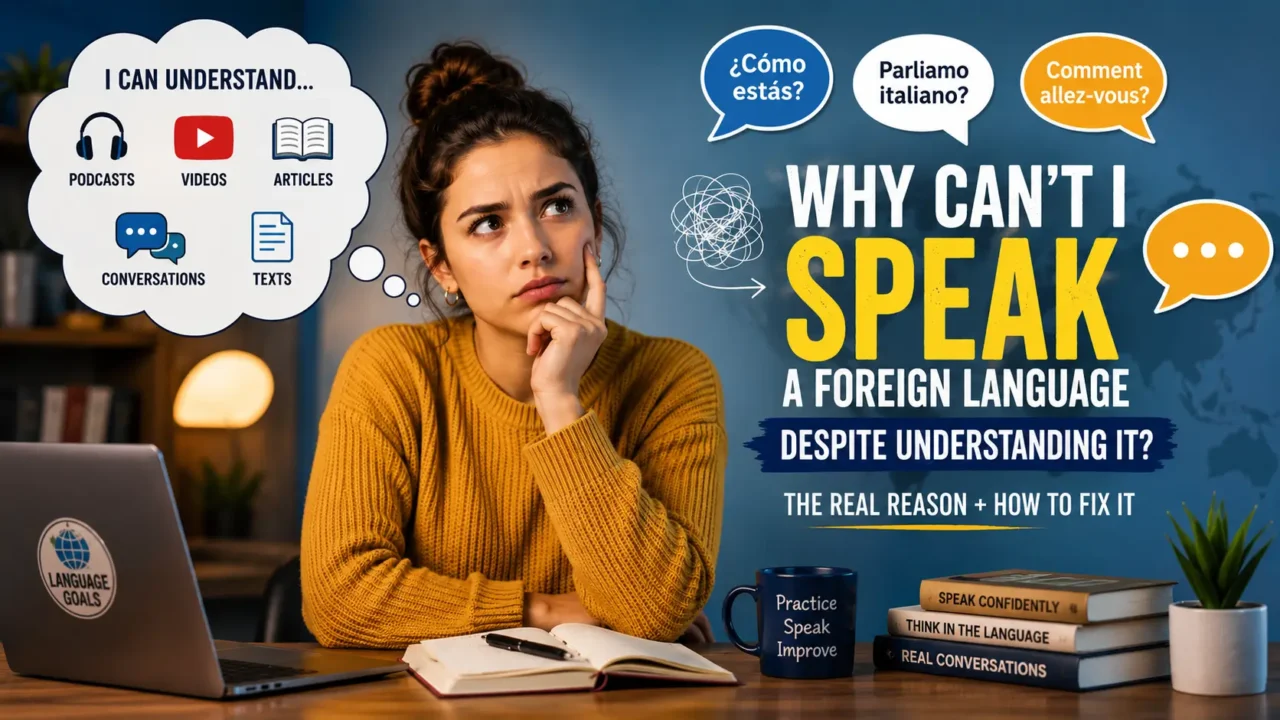
Why Can’t I Speak a Foreign Language Despite Understanding It?
Quick Summary
▸More than 50% of learners report high speaking anxiety → speaking is the hardest skill for most learners.
▸Speaking anxiety is the #1 reported language-learning barrier → it affects fluency more than grammar knowledge
▸Comprehension develops faster than speaking by ~1 standard deviation → understanding grows faster than production
▸Input alone is not enough for speaking ability → output practice is required to convert knowledge into speech
▸Most learners are not stuck due to talent → they are missing structured speaking exposure.
You understand podcasts. You follow YouTube videos. You can read articles without much effort.
Then someone asks you a simple question in your target language and your mind goes completely blank.
If that sounds familiar, you’re not alone.
Many learners ask themselves; why can’t I speak a foreign language despite understanding it well and the answer is simpler than most expect.
Research on foreign language anxiety found that more than half of language learners experienced high levels of speaking anxiety, making speaking the most stressful part of language learning for many people. Speaking anxiety also tends to be higher than anxiety related to reading, listening, or writing.
The frustrating part is that many learners assume something is wrong with them.
It usually isn’t.
In reality, understanding a language and speaking a language rely on different skills. Your brain can become very good at recognizing words and structures long before it becomes comfortable producing them.
This article explains why that gap happens, how to identify what’s causing it in your case, and what you can do to close it.
What is it called when you understand a language but can’t speak it?
The most common term is receptive bilingualism, which means your understanding is stronger than your ability to produce the language.
Researchers describe a receptive-expressive gap as a situation where language comprehension develops faster than language production.
In simple terms, your brain has learned to recognize the language, but it has not yet developed the ability to use it automatically in real-time conversation.
This phenomenon is common among:
- Language learners
- Heritage language speakers
- Children raised in bilingual households
- Adults who consume lots of content but rarely speak
The important thing to remember is that understanding a language is not evidence that speaking should already be easy. These are related skills, but they do not develop at the same speed.
Many learners mistakenly treat the gap as a failure. In reality, it is often a predictable stage of language development.
Why does comprehension develop faster than speaking?
Comprehension develops faster because recognizing language requires less cognitive effort than producing it.
When you listen, your brain receives information and identifies patterns.
When you speak, your brain must:
- Choose the right words
- Build a sentence
- Apply grammar
- Pronounce sounds correctly
- Monitor mistakes
- Respond in real time
That is a much heavier workload.
Research published in Frontiers in Psychology found that receptive language abilities can significantly exceed expressive abilities, with differences approaching one standard deviation in some learners.
One explanation is the exposure hypothesis. Learners receive far more listening and reading input than speaking opportunities, so comprehension naturally grows faster.
The second explanation comes from Swain’s Output Hypothesis. According to Swain, language learners need output practice because producing language forces them to notice gaps in their knowledge and convert passive knowledge into active skill.
You can know a grammar rule intellectually and still struggle to use it during a conversation.
That is why someone can understand 90% of a podcast but struggle to answer a simple question.
Input builds knowledge. Output builds speaking ability.
Understanding a language and speaking a language are different skills.
The gap between them is normal and usually reflects a lack of output practice, not a lack of intelligence or talent.
Which problem is actually holding you back?
Most learners fall into one of four categories. Identifying the right one matters because each problem requires a different solution.
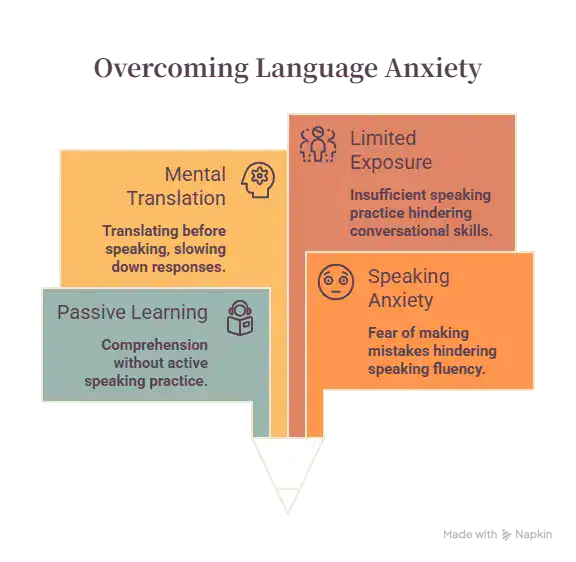
You’ve been doing passive learning without output practice
If most of your learning comes from YouTube, Netflix, podcasts, books, or language apps, you may have developed strong comprehension without developing speaking skills.
This is extremely common.
Passive learning feels productive because you can see measurable progress. You understand more content every month.
The problem is that recognition and production are not the same thing.
You recognize words when somebody else uses them. Speaking requires retrieving those same words on demand.
The fix is straightforward:
- Start speaking earlier
- Use daily self-talk
- Record yourself answering questions
- Participate in conversations even when they feel uncomfortable
- Accept that mistakes are part of the process
Many learners spend years waiting until they feel “ready” to speak.
Speaking is often what creates readiness.
You freeze because of speaking anxiety
If you know the words but panic when someone talks to you, anxiety may be the real issue.
As mentioned earlier, research consistently shows that speaking anxiety is often the strongest form of language-learning anxiety.
Anxiety affects working memory. When stress rises, it becomes harder to retrieve vocabulary and grammar that you already know.
This creates a vicious cycle:
- You worry about making mistakes.
- Your performance drops.
- The experience feels embarrassing.
- Anxiety increases next time.
The solution is not necessarily more grammar study.
Instead, reduce the emotional pressure associated with speaking.
Helpful approaches include:
- Practicing with AI conversation tools
- Speaking to yourself daily
- Recording voice notes
- Having short conversations instead of long ones
- Focusing on communication rather than perfection
If the anxiety you’re describing is really about the moment a mistake happens, rather than speaking itself, why you’re afraid of making mistakes when speaking a foreign language breaks down the psychology behind that specific fear and a 30-day protocol to work through it.
The goal is to teach your brain that speaking is safe.
If anxiety is your main barrier, an AI tutor removes the judgment that makes speaking feel high-stakes. AI tutors for language learning covers the best options for low-pressure daily practice.
You’re translating in your head instead of thinking in the language
Many intermediate learners silently translate every sentence before speaking.
This creates a bottleneck.
Instead of responding naturally, your brain follows a slower process:
Native language → Translation → Target language → Speech
Conversation moves too quickly for that workflow.
Signs this is your problem include:
- Long pauses before speaking
- Knowing vocabulary but responding slowly
- Feeling mentally exhausted after conversations
To reduce translation dependence:
- Use simple language you already know
- Practice common conversation patterns
- Build automatic responses
- Describe your surroundings in the target language
- Think through daily tasks without switching back to your native language
The goal is not perfect thinking in the language.
The goal is reducing the number of translation steps required.
That gap between understanding and speaking often comes down to mental translation still running in the background, which is worth understanding on its own: why you translate in your head before you speak.
You haven’t had enough speaking exposure, not just listening exposure
Listening exposure helps you understand how a language sounds.
Speaking exposure teaches your brain how conversations actually work.
Many learners underestimate how different those experiences are.
Conversation requires:
- Turn-taking
- Clarification requests
- Follow-up questions
- Interruptions
- Real-time adjustments
You do not learn these skills by listening alone.
If you rarely participate in conversations, your speaking ability may simply reflect limited speaking exposure.
The fix is deliberate conversation practice.
That can include:
- Language exchanges
- Tutors
- Group classes
- AI conversations
- Speaking clubs
Consistency matters more than intensity.
Ten minutes every day is usually more valuable than one long session every two weeks.
If structured live classes appeal to you more than self-directed practice, our Lingoda review covers what the lessons actually feel like from someone who has taken them, including whether the speaking pressure is manageable for anxious learners.
What exercises can I start today to bridge the gap?
The fastest way to improve speaking is to increase output while keeping the difficulty manageable.
1. Shadowing
Listen to a short audio clip and repeat it immediately.
Focus on rhythm, pronunciation, and flow rather than perfection.
Even five minutes per day can help build automatic speaking patterns. For a deeper look at which pronunciation errors are worth fixing and which ones don’t actually affect understanding, see how to fix pronunciation problems.
2. Self-talk
Narrate your day in your target language.
Describe what you’re doing, what you’re planning, or what you’re seeing.
This removes the pressure of interacting with another person.
3. AI conversation practice
AI conversation tools provide unlimited speaking opportunities.
They are especially useful for anxious learners because mistakes carry no social consequences.
Try discussing familiar topics first before moving to more complex conversations.
4. Tutored speaking sessions
A good tutor can identify weaknesses and push you slightly beyond your comfort zone.
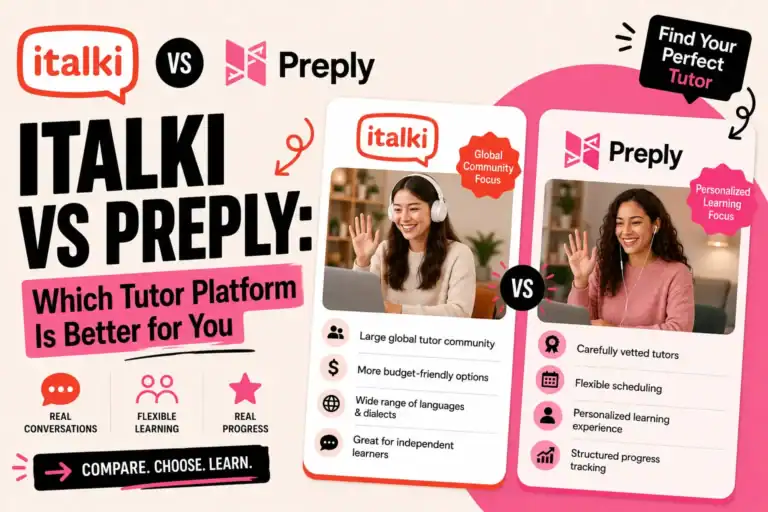
Platforms such as Italki and Preply are popular because they provide regular opportunities for guided speaking practice.
The biggest advantage is accountability.
You cannot hide behind passive learning during a live conversation.
5. The 4-3-2 technique
Choose a simple topic and explain it:
- For 4 minutes
- Then 3 minutes
- Then 2 minutes
Use the same topic each time.
Because the content is familiar, your speaking becomes faster and more automatic with each repetition.
Many learners notice immediate improvements in fluency during a single session.
For output practice you can do anytime without scheduling a human tutor, AI chatbots for language practice gives you a full breakdown of what works and what doesn’t.
How long does it take to close the comprehension-speaking gap?
There is no fixed timeline, but most learners see progress once speaking becomes a regular part of their routine.
As we explored above, the exposure hypothesis suggests that skills improve through repeated exposure and use.
The key variable is not time alone.
It is speaking volume.
A realistic framework looks like this:
First 30 days
- Daily speaking habit established
- Reduced fear of making mistakes
- Faster word retrieval
- More comfort producing simple sentences
First 60 days
- Conversations feel less mentally exhausting
- Fewer pauses for translation
- Better pronunciation and rhythm
- Increased confidence
First 90 days
- Noticeably smoother conversations
- More automatic grammar use
- Improved ability to discuss unfamiliar topics
- Stronger speaking endurance
Results vary based on language difficulty, prior experience, and practice frequency.
What does not usually work is continuing to consume input while avoiding speaking.
The gap closes when speaking becomes part of your learning system.
Not sure whether a paid tutor or a free conversation partner is the right next step? Online language learning platforms: tutoring vs exchange lays out the trade-offs clearly.
Does speaking practice matter more than grammar study?
For learners stuck in the comprehension-speaking gap, speaking practice is usually more important than additional grammar study.
That does not mean grammar is useless.
Grammar provides structure.
The problem is that many learners continue collecting grammar knowledge they already understand instead of practicing how to use it.
If you can already recognize a grammar pattern while reading or listening, your next bottleneck is often production.
In other words:
- Grammar builds knowledge.
- Speaking builds performance.
The best results usually come from combining both.
We’ll cover this topic in more depth in a dedicated article comparing speaking practice and grammar study directly.
If you’re ready to put the speaking into practice, our guide to the best apps for speaking practice breaks down exactly which tool fits which stage of your output gap.
Worth Reading Next
If you’re deciding how to get more speaking practice, these guides are a good next step:
Conclusion
If you understand a foreign language but struggle to speak it, the problem is probably not intelligence, motivation, or talent.
The more likely explanation is that your comprehension skills have developed faster than your speaking skills.
That is normal.
For most learners, the solution is not another grammar book or another hundred hours of passive input.
The solution is targeted output practice.
Start small. Speak every day. Accept mistakes. Focus on consistency.
Your speaking ability does not appear overnight.
It grows every time you force passive knowledge to become active language.
And once that process starts, the gap between understanding and speaking becomes much smaller than it feels today.
Frequently Asked Questions
What is receptive bilingualism?
Receptive bilingualism describes a situation where someone understands a language significantly better than they can speak it. Researchers often refer to this as a receptive-expressive gap
Why can’t I speak a foreign language despite understanding it?
Speaking anxiety can interfere with word retrieval and working memory. Even when you know the vocabulary, stress can make it difficult to access it quickly during conversation
Can you become fluent just by listening and watching TV?
Listening and watching content help build comprehension, but speaking usually requires output practice. Swain’s Output Hypothesis argues that producing language plays a critical role in developing active language ability
What is the 4-3-2 technique for speaking practice?
The 4-3-2 technique involves repeating the same topic three times while reducing the time available from four minutes to three minutes to two minutes. This encourages faster and more automatic speech production.
How do AI tutors help with the comprehension-speaking gap?
AI tutors provide low-pressure opportunities to practice speaking. Unlike live classes, there is no fear of judgment. Structured programs such as Lingoda provide the opposite benefit by introducing real-time speaking pressure in a guided environment.