
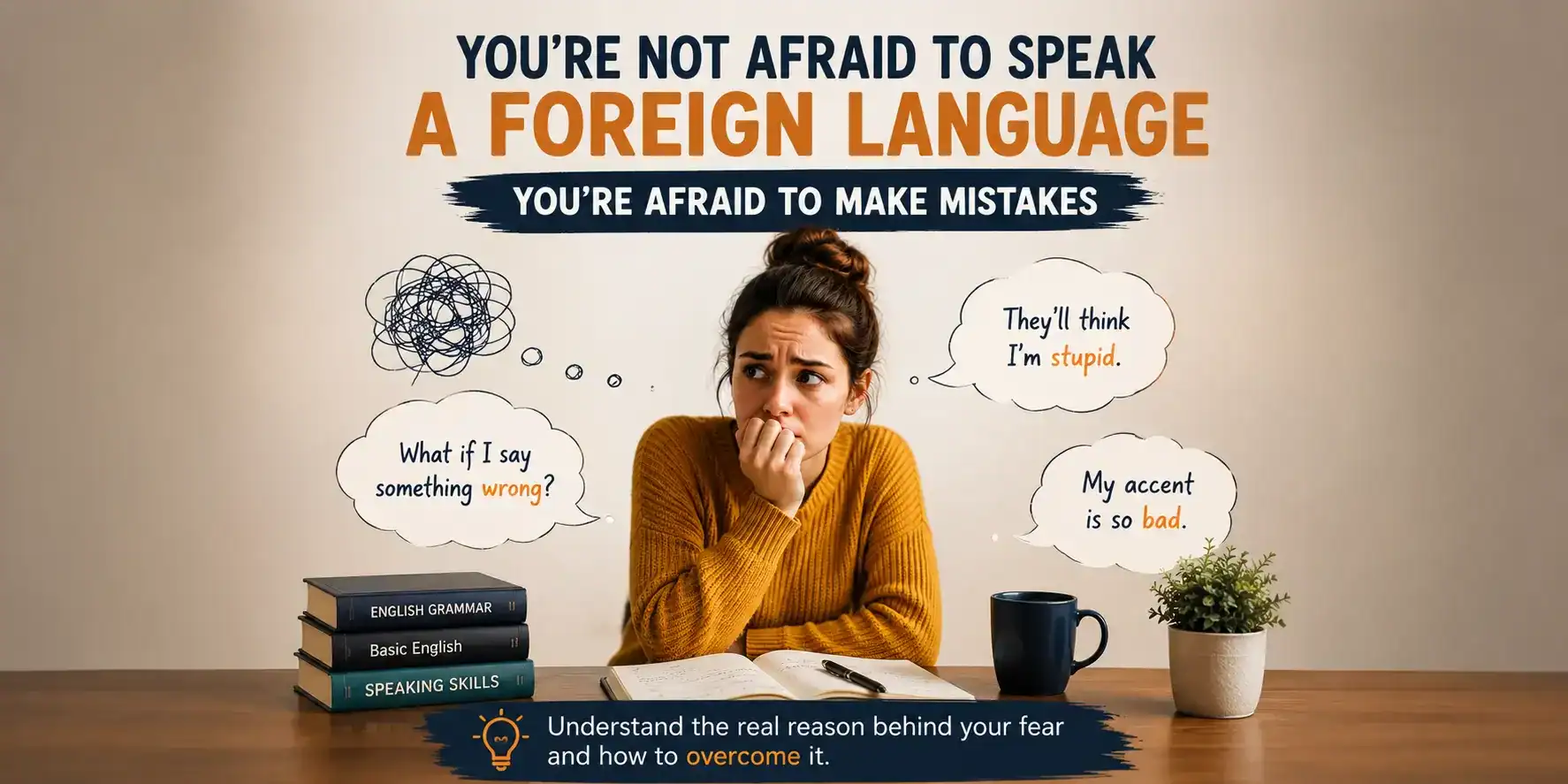
Why You’re Afraid of Making Mistakes When Speaking a Foreign Language (And How to Fix It)
Quick Summary
▸Fear of negative evaluation is one of three core components of foreign language anxiety (FLA)
▸64% of surveyed learners named fear of making mistakes as their top language-learning anxiety source
▸Speaking a second language under social evaluation produces a measurably larger cortisol spike than speaking a first language
▸Language ego, a concept introduced by Guiora in 1972, explains why mistakes in a second language can feel like a threat to identity, not just a skill gap
▸Graduated exposure, ranking feared situations from least to most distressing, is the standard clinical method for reducing anxiety responsesly
In one study of language learners, 64% identified the same root cause of their anxiety: fear of making mistakes, the single highest-rated source of test anxiety in the study. Not grammar. Not vocabulary gaps. The fear of getting it wrong.
Here’s the problem with most advice on this: it treats the fear as a vague, general thing. “Relax.” “Practice more.” “Believe in yourself.” None of that touches the actual mechanism, because the actual mechanism is specific. You’re not afraid of the language. You’re afraid of what a mistake in that language says about you, in front of someone who’s listening.
This post breaks that down properly: what’s actually happening psychologically and physically when you freeze up over a mistake, why it tends to get worse rather than better as you improve, and a structured 30-day protocol to retrain the response, not just white-knuckle through it.
Why Are You So Afraid of Making Mistakes in a Foreign Language?
You’re afraid of mistakes in a foreign language because your brain treats a language error as a social threat, not a technical one. This is called fear of negative evaluation, one of three components of foreign language anxiety (FLA) identified by Horwitz, Horwitz & Cope in their original 1986 paper .
FLA isn’t generic nervousness. It’s a distinct, measurable construct, specific to the act of learning or using a foreign language, and it’s made up of three overlapping parts:
- Fear of negative evaluation – worry about how you’ll be perceived if you get it wrong
- Communication apprehension – discomfort with not being able to express complex thoughts
- Test anxiety – stress tied to formal evaluation, like exams or graded speaking tasks
Fear of mistakes sits almost entirely inside that first component. It’s the one most learners recognize instantly, because it’s the one that shows up the moment you open your mouth.
The problem isn’t that you’re bad at the language.
The problem is that you treat mistakes as evidence of failure instead of evidence of learning.
Why Does Your Brain Treat a Language Mistake Like a Threat?
Your brain reacts to a language mistake the way it reacts to a real social threat, because speaking under judgment triggers an actual stress response, not just a feeling.
In a 2019 study, researchers had participants complete a stress test either in their first language or a perceived second language. The group speaking the second language showed a significantly larger cortisol spike.
That matters because cortisol doesn’t just make you feel anxious. Elevated cortisol interferes with hippocampal function, which is the part of your brain responsible for retrieving long-term memory, including the vocabulary and grammar you’ve already learned. This creates a loop: the fear of a mistake raises stress hormones, the stress hormones block your ability to retrieve the correct word, and the resulting mistake (or blank silence) confirms the fear that started the cycle.
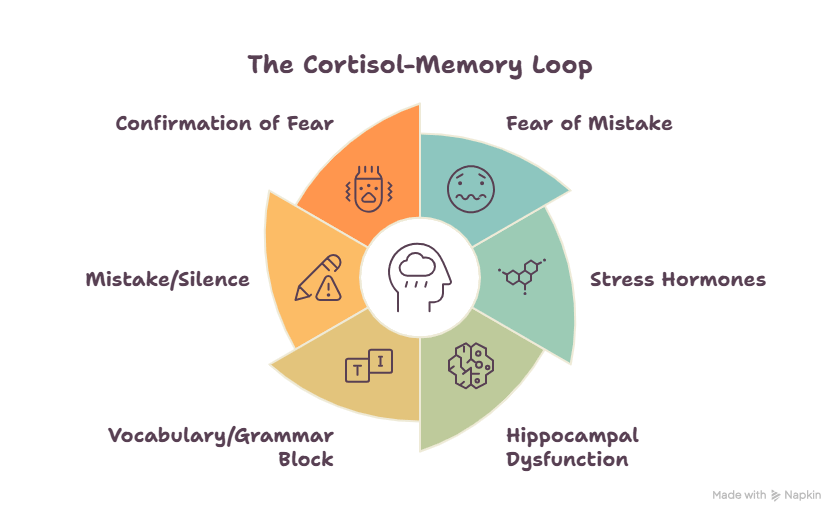
This is also why you can know a word perfectly well in a quiet room alone, then lose it completely the second someone’s listening. The knowledge didn’t disappear. The retrieval got blocked by the threat response. Some of that hesitation isn’t fear at all, it’s your brain still translating before it lets you speak, which has its own set of causes and fixes: why you translate in your head before you speak.
Researchers have also identified specific brainwave patterns, a measure called frontal alpha asymmetry, that show up during this kind of anxious language production, reflecting a neural shift toward withdrawal rather than engagement.
If the experience you’re describing is less “I’m scared of mistakes” and more “the words are just gone,” this breakdown of why you can’t speak a foreign language despite understanding it covers the other elements at play.
Is Perfectionism Making Your Language Anxiety Worse?
Perfectionism makes language anxiety worse because the bar for “good enough” keeps moving as your skill improves, so the fear doesn’t shrink, it relocates. This connects to two ideas from anxiety research: self-efficacy and appraisal.
Appraisal theory says your anxiety depends on how threatening you perceive a situation to be. Self-efficacy is your confidence in handling that threat. The catch for perfectionists is that as your actual ability improves, your threshold for an acceptable mistake gets stricter. A beginner forgives themselves for mixing up verb tenses. An intermediate learner who makes the same mistake feels like they should know better by now.
There’s also a concept linguists call “language ego” : because language is tied to identity, a mistake in your target language can feel like a threat to your sense of self, not just a technical slip-up. That’s part of why this fear doesn’t politely fade with fluency. It often gets more personal.
The 30-Day Mistake-Exposure Protocol
The fastest way to stop fearing mistakes is to deliberately make them, on purpose, at a pace your nervous system can handle, starting from situations with almost no social stakes and building up from there. This is based on graduated exposure, a well-established approach in anxiety treatment that works by ranking feared situations from least to most distressing, then working through them in order.
Here’s a four-step version built specifically around mistakes, not general speaking practice.
Step 1: Build Your Mistake Hierarchy (Days 1-3)
Write down 8-10 specific mistake scenarios, not general “speaking situations.” Be precise:
- Mispronouncing a word while ordering coffee from a stranger
- Forgetting a verb conjugation mid-sentence with a tutor
- Using the wrong gender for a noun in front of a native speaker
- Going completely blank in a group conversation
Rank them from least to most frightening. This list is your map for the next 27 days.
Step 2: Low-Stakes Mistakes (Days 4-12)
Start at the bottom of your hierarchy, alone. Record yourself speaking and deliberately leave a mistake in, without re-recording to fix it. Talk to yourself out loud in the target language. The goal here isn’t to avoid errors, it’s to sit with the discomfort of an unfixed mistake existing, even with no one watching.
Step 3: Witnessed Mistakes (Days 13-22)
Move to one trusted person: a patient native speaker, a language exchange partner, or a tutor. Tell them in advance you’re practicing tolerating mistakes, not perfection. When you slip up, practice not over-correcting or apologizing three times in a row.
Having a few ready-made openers takes pressure off this stage. Try lines like: “Sorry if I get this wrong, but how do you say…?” or “I might make a mistake here, just let me finish.”
Step 4: Public Mistakes (Days 23-30)
Move into group settings or unscripted real-time conversation, where correction isn’t guaranteed and you can’t control the pace. Practice letting an error pass without mentally spiraling into the rest of the conversation. This is the stage where the fear of judgment gets tested against reality, and reality is usually far less harsh than the fear predicted.
For structured environments to run this protocol in, especially stages 2 and 3, this roundup of the best apps for speaking practice breaks down which tools work best at each stage, including low-pressure AI conversation options for the earliest steps.
What Should You Do the Moment You Make a Mistake Out Loud?
The moment you make a mistake out loud, briefly acknowledge it if needed, then keep going without dwelling on it. A quick “sorry, I meant…” takes two seconds. Three apologies and a long explanation of what you meant to say takes the conversation hostage and signals to everyone, including your own brain, that something serious just happened.
Native speakers and tutors deal with learner mistakes constantly. To you it feels significant. To them, it’s Tuesday.
My Own Experience With Fear of Mistakes
I tested this firsthand when I took six live Italian classes with Lingoda to write a review of the platform. I’m not a natural extrovert, and I went into the first two sessions genuinely anxious, not because of the grammar, but because I knew I’d be making mistakes in front of a teacher and other students in real time.
That feeling didn’t last. The teachers weren’t there to catch me out, they were there to move me forward. By the third class, something had shifted: I was answering questions without mentally rehearsing every word first. The mistakes hadn’t stopped happening. I’d just stopped treating each one as evidence I didn’t belong in the class.
The bigger surprise came afterward, in the personal class reports each teacher wrote after every session. Mine consistently said the same thing: solid vocabulary, decent pronunciation, weak grammar. That’s a very different fear than “I’ll sound stupid.” A vague fear of mistakes keeps you guessing. A specific, named gap gives you something to actually work on, which is a lot less frightening than the blur of “I might mess up” that anxiety prefers to deal in.
The same principle applies to tracking progress more broadly: measuring progress in speaking a new language replaces that same blur with something concrete to check against.
Pronunciation worries deserve their own diagnosis too, covered in how to fix pronunciation problems.
Tools and People That Help You Practice Making Mistakes Safely
The fastest way to get comfortable making mistakes out loud is to practice with people who are structurally expected to correct you, since that removes judgment from the equation entirely. A tutoring relationship works differently from a casual conversation: correction is the job, not an awkward intrusion.
Comparing Italki and Preply is a useful next step for finding the right kind of tutor for the witnessed-mistake stage of the protocol, since tutoring style varies a lot between the two.
For a more structured class environment built specifically with nervous speakers in mind, this review of Lingoda covers what the class format actually feels like when you’re the one fumbling through a sentence, including the placement-test mismatch I ran into and how the teachers handled it.
A Few More Useful Guides
If you want to go deeper:
- Best Language Learning Platforms With Tutors
- Language Tutoring vs. Exchange: How Online Platforms Compare
- Preply Review 2026: Real Tutors, Real Results
Conclusion
The fear was never really about the language. It was about what a mistake might say about you, in front of someone listening. Foreign language anxiety, and the fear of negative evaluation specifically, is a documented, measurable response, not a personal failing, and it responds to structured exposure the same way other forms of anxiety do.
Pick one item from the bottom of your mistake hierarchy. Make that mistake on purpose today, out loud, even if it’s just to yourself in an empty room. That’s day one.
Frequently Asked Questions
Is fear of making mistakes the main cause of language anxiety?
It’s one of three documented components of foreign language anxiety, alongside communication apprehension and test anxiety, but research suggests it’s the one most learners experience most strongly and recognize most easily
Will native speakers really judge me for mistakes?
Most won’t, and many actively appreciate the effort, but the fear isn’t really about their actual reaction. It’s about your brain’s prediction of their reaction, which tends to be far harsher than reality.
Does this fear go away as you get more fluent?
Not automatically. Because the bar for “acceptable” rises with skill, many learners report feeling more anxious, not less, as they improve, since mistakes start to feel less excusable.
What’s the fastest way to get comfortable making mistakes out loud?
iberate, graduated exposure: start by making small mistakes alone, then in front of one trusted person, then in group settings, rather than waiting until you feel ready.
Does fear of mistakes affect oral exam performance specifically?
es, test anxiety is itself one of the three FLA components, so learners who are highly mistake-averse often see this compound during graded oral exams. That’s a distinct enough scenario that it deserves its own dedicated approach beyond what’s covered here.