Rosetta Stone Review: What 30 Years Built (And Missed)
Quick Summary
▸Rosetta Stone has run on the same core idea since 1992: no translation, just images, audio, and pattern recognition (called Dynamic Immersion)
▸The product has been rebranded as Rosetta Stone Sapphire in the US market specifically; the EU site shows no sign of this rebrand and still runs the classic Rosetta Stone experience with a lifetime plan intact
▸Current US pricing: $19.99/month or $13.25/month billed yearly at $159. Current EU pricing: €199 lifetime (best value) or subscription tiers from €10.95/month
▸Covers 25 languages, with speech feedback through its TruAccent tool
▸Conversation practice now runs through Chat Missions, a scripted scenario feature, not open-ended AI conversation
▸Best for: visual learners building vocabulary and pronunciation. Not built for: learners who want grammar explanations or live, unscripted speaking practice
Rosetta Stone has been promising the same thing for over three decades: learn a language the way you learned your first one, by absorbing it, not translating it. That pitch built a brand most people recognize even if they’ve never opened the app. But here’s the tension worth sitting with before you buy: the underlying method has barely moved while the rest of the category has been reshaped by AI conversation tools that didn’t exist five years ago.
This Rosetta Stone review breaks down what that 30-year-old method still does well, what the recent Sapphire rebrand actually changed (including pricing), and where the gaps are if your goal is real conversation, not just recognition.
What Is Rosetta Stone?
Rosetta Stone is a language-learning platform built around an immersion method called Dynamic Immersion: you learn through images, audio, and repetition, with no translation into your native language at any point. The company has been around since 1992 and is now a division of IXL Learning, a Brisbane-based education company that also owns brands like Wyzant and Vocabulary.com.
The “no translation” rule is the whole identity of the product. From lesson one, everything happens in your target language. You match pictures to words and sounds, not English definitions to foreign words.
How Does Rosetta Stone Work?
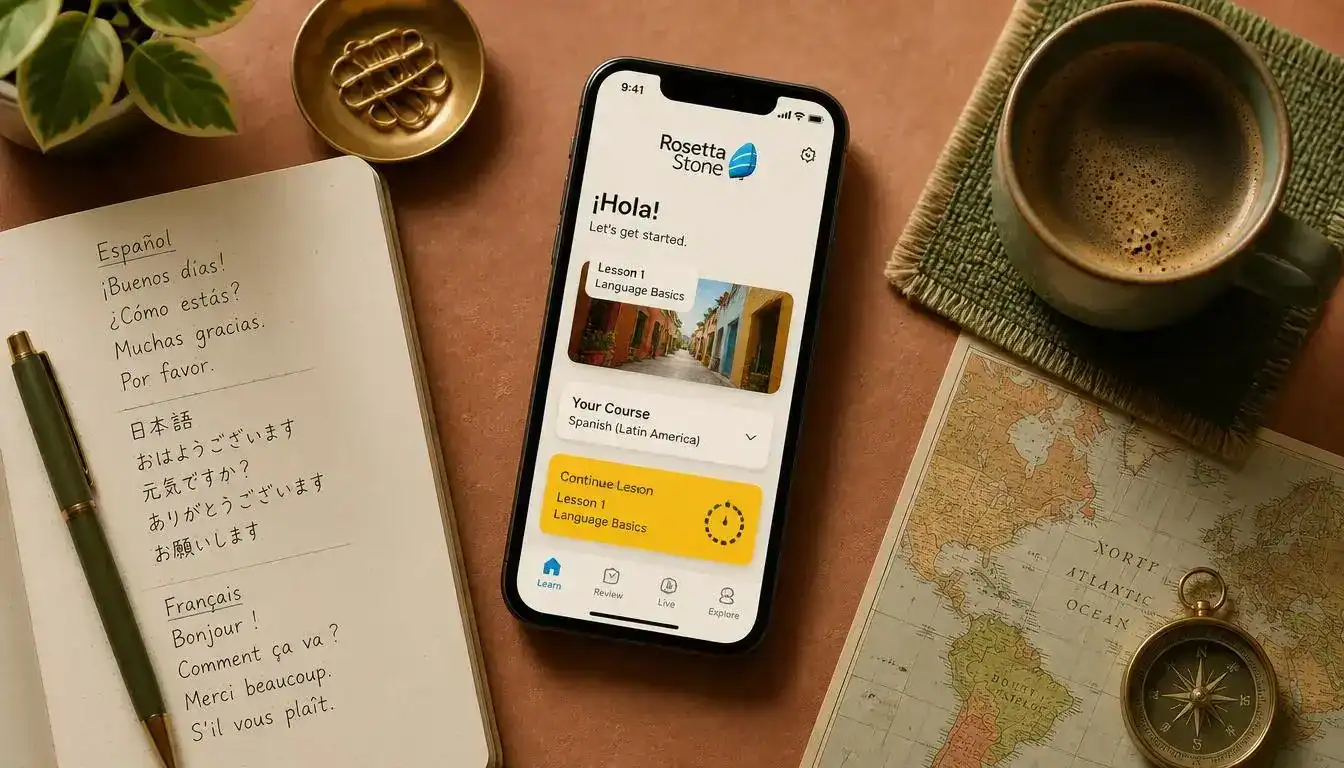
Rosetta Stone runs you through themed units (greetings, travel, shopping, work) using picture-matching exercises, audio from native speakers, and a built-in speech tool called TruAccent that scores your pronunciation in real time. Each language now covers 25 total languages, included on a single subscription rather than priced per language, at least under the new US “Sapphire” version of the product.
Conversation practice happens through a feature called Chat Missions, which simulate everyday scenarios like checking into a hotel or ordering food. This is where the method shows its age. This kind of interaction as scripted dialogue with pre-recorded speakers rather than open-ended conversation, means you can’t improvise, ask a follow-up question, or go off-script the way you would with a real person or a modern AI conversation partner. For a beginner building recognition, scripted scenarios are fine. For someone who actually needs to hold an unscripted conversation, it’s a real limitation.
There’s also a separate Live tutoring option: 25-minute sessions with native-speaking tutors, available solo or in small groups. However as Rosetta Stone’s own support documentation also notes that tutoring offerings vary by user, account type, and region, and aren’t guaranteed for every consumer, so whether you get access at all depends on where you’re signing up from and which plan you’re on. In essence they are not bundled into the basic subscription, they’re a paid add-on on top of your plan.
Rosetta Stone also runs free, group-streamed “Live Lessons” on cultural and conversational topics, included with an active subscription in most markets, but those are closer to a class you watch and chat in than one-on-one practice.
TruAccent itself is solid for what it does, scoring pronunciation against native-speaker audio in real time, but it’s a single built-in tool rather than a dedicated focus. If pronunciation accuracy is your main concern, it’s worth seeing how purpose-built AI pronunciation coach tools compare on accuracy and feedback depth.
If adaptive, AI-driven conversation practice matters more to your goals than scripted scenarios, it’s worth comparing how today’s AI language tutors handle real-time dialogue instead.
Is Rosetta Stone Actually Worth It?
It’s worth it if your goal is building intuitive vocabulary and clean pronunciation through repetition, and not worth it if your goal is holding a real conversation soon. Those are two different outcomes, and most of the confusion around this product comes from people expecting the second while only getting the first.
Will Rosetta Stone Make You Fluent?
No single app makes anyone fluent on its own, but Rosetta Stone specifically struggles with the final stretch toward fluency: spontaneous conversation. You’ll build a real foundation. You won’t get to fluent conversation without adding something else on top.
Is Rosetta Stone Worth It Today?
Here’s the honest verdict: the immersion method is still genuinely effective for what it’s designed to do, vocabulary acquisition through pattern recognition without translation crutches, but the product hasn’t kept pace with how AI has changed conversation practice. The Sapphire rebrand updated the packaging and the pricing model, but the core conversation gap from years ago is still the core conversation gap today.
How Much Does Rosetta Stone Cost?
This is the part where it gets interesting, because the pricing now depends on which regional site you land on. As of June 2026, confirmed directly on Rosetta Stone’s own pricing page:
On the US site, now rebranded as Sapphire, the lifetime plan is gone. You get two subscription tiers only:
Plan | Price | Notes |
|---|---|---|
Monthly | $19.99/month | Billed monthly, full access to all 25 languages |
Yearly | $13.25/month | Billed yearly at $159, marked “Save 33%” |
On the EU site, the lifetime plan is still there, and it’s the headline offer. Pricing shown there:
Plan | Price | Notes |
|---|---|---|
Monthly | €14.95/month | €44.85 total, discounted from €59.85 |
Yearly | €10.95/month | €131.40 total, discounted from €239.40 |
Lifetime | €199 one-time | Discounted from €399, marked “Best Value,” all 25 languages |
So depending on where you’re buying from, the math is completely different. US shoppers are pushed toward a subscription-only model. EU shoppers still get the one-time lifetime option most older reviews (including some of ours) assumed was universal. If you’re outside the US, check the lifetime price before defaulting to a subscription, since it’s still positioned as the better long-term value there.
What Are the Pros and Cons of Rosetta Stone?
Pros:
- Clean, ad-free interface that’s stayed consistent across the rebrand
- TruAccent pronunciation feedback is genuinely useful for building accurate speech habits
- No-translation method builds intuitive vocabulary recognition effectively
- Single subscription now covers all 25 languages, with no per-language upsell
- Money-back guarantee on new subscriptions (14 days in the US, 30 days in the EU)
Cons:
- Minimal grammar explanation, which leaves gaps for learners who need explicit rules
- Chat Missions are scripted, not open-ended, so they don’t replace real conversation practice
- Lifetime-access pricing now varies by region, gone from the US site, still available in the EU, which makes comparing reviews and prices confusing
- Early units can feel repetitive before the content variety picks up
- Live tutoring with real native speakers exists, but it’s a paid add-on and it’s availability varies by region and account type”
How Does Rosetta Stone Compare to Babbel and Duolingo?
|
|
| |
|---|---|---|---|
Method | Immersion, no translation | Translation-based, grammar-focused | Gamified, bite-sized |
Grammar instruction | Minimal | Strong | Light |
Conversation practice | Scripted (Chat Missions) | Limited | Limited |
Pricing model | Subscription (US) or lifetime €199 (EU) | Subscription | Freemium |
Best for | Visual learners, vocabulary building | Practical conversation skills | Habit-based, casual learning |


For a deeper side-by-side on grammar instruction and conversational outcomes, our full Babbel vs Rosetta Stone comparison breaks down which one wins for different learner types.
Can Rosetta Stone Teach Languages With Different Scripts?
Yes, but with added friction for languages like Japanese, Russian, or Arabic that use non-Latin scripts. Rosetta Stone teaches you to recognize characters like hiragana, katakana, and kanji in context, but it doesn’t break down stroke order or the building-block components that make those characters easier to retain long-term. For script-heavy languages, plan to pair Rosetta Stone with a dedicated script-learning resource rather than relying on it alone.
Who Is Rosetta Stone Best For?
- Beginners who want a structured, no-frills immersion experience
- Visual and auditory learners who absorb patterns better than explicit rules
- Anyone who wants an ad-free, distraction-free interface
- Learners who already have a grammar resource and want a vocabulary-building companion alongside it
Who Should Skip Rosetta Stone?
- Anyone targeting conversational fluency on a short timeline
- Learners who need explicit grammar rules to feel confident
- Budget-conscious beginners who want to test the waters with a free tier first
If you’re a beginner weighing free and low-cost options before committing to a paid platform, our guide to the best language learning apps for beginners is the right next stop.
For learners who already know immersion alone won’t get them speaking fluently, our roundup of platforms with live tutors covers the speaking-practice side Rosetta Stone doesn’t.
The Verdict
Rosetta Stone’s immersion method still does one thing well after 30 years: building intuitive vocabulary and clean pronunciation without translation crutches. What it hasn’t built is a real answer to spontaneous conversation, and the Sapphire rebrand changed the pricing model without closing that gap, with lifetime access now only available outside the US.
If the no-translation approach fits how you learn and you’re building a foundation, it’s a reasonable choice either way. If you’re trying to actually speak fluently soon, pair it with a conversation-focused tool or compare your options in our Best Language Learning Apps for Fluency before you commit.
Frequently Asked Questions
Is Rosetta Stone good for complete beginners?
Yes. The no-translation, image-based approach is specifically designed for learners with no prior exposure to the language, and the structured units build vocabulary progressively.
Is the Rosetta Stone lifetime plan still available?
It depends on your region. The US version, now rebranded as Sapphire, only offers Monthly ($19.99/mo) and Yearly ($13.25/mo, billed at $159) subscriptions, no lifetime option. The EU site shows no sign of the Sapphire rebrand and still sells lifetime access for €199, listed as the best-value plan.
Is Rosetta Stone or Duolingo better for grammar?
Neither is strong on explicit grammar instruction. Babbel is the stronger option of the three if grammar instruction is your priority.
Can children use Rosetta Stone?
Yes, the image-based, no-translation format works well for younger learners since it doesn’t rely on reading comprehension in a second language to function.
Does Rosetta Stone offer live tutoring?
Yes, but availability isn’t guaranteed everywhere. Rosetta Stone’s own support documentation states tutoring offerings vary by region and account type, and where available, it’s a paid add-on rather than included in the base subscription. Free, group-streamed ‘Live Lessons’ are more widely included with an active subscription.