
How to Measure Progress in Speaking a New Language
Quick Summary
▸What “progress” means: movement between recognized speaking levels (CEFR, ACTFL), not how many words you’ve memorized
▸Formal benchmark: the CEFR self-assessment grid rates speaking across 6 levels, A1 to C2, and needs no test center
▸Time reality: the Foreign Service Institute puts Category I languages at 552 to 690 class hours to reach professional speaking proficiency, with harder languages needing far more
▸Informal check: a 2 minute monthly self-recording is the single most repeated self-assessment method across language experts
▸Bottom line: run both tracks at once. One formal benchmark every few months, one informal check every few weeks.
Most people learning a new language can tell you exactly how many hours they’ve put in this month. Ask them what CEFR or ACTFL level they’ve actually reached, and most go quiet. That gap, between effort tracked and progress measured, is where a lot of learners quietly give up, not because they’ve stopped improving, but because they’ve stopped being able to see it.
To measure progress in speaking a new language properly, you need two different tools working together: a formal benchmark that tells you where you objectively stand, and an informal check that catches the small, daily wins a formal test misses. This guide walks through both, how often to use each one, and why the answer changes depending on which language you’re learning.
What “Progress” Actually Means When You’re Learning to Speak
Progress in speaking means moving up a recognized proficiency scale, not accumulating vocabulary or study hours. A learner who knows 3,000 words but freezes in conversation has not progressed in speaking, even if their flashcard app says otherwise.
This matters because vocabulary size and speaking ability grow at different rates. You can recognize a word on a flashcard for months before you can produce it under the pressure of a real conversation. The two most widely used speaking-specific scales are the CEFR (Common European Framework of Reference) and ACTFL (American Council on the Teaching of Foreign Languages). Both describe what you can actually do out loud, not what you’ve studied.
The Formal Way to Measure Progress in Speaking: CEFR and ACTFL Levels
What the CEFR Self-Assessment Grid Actually Measures
The CEFR splits speaking into six levels: A1 and A2 (Basic User), B1 and B2 (Independent User), and C1 and C2 (Proficient User). At A2, you can handle a predictable exchange like ordering food. At B1, you can hold a conversation on a familiar topic without rehearsing it first. At B2, you can talk with a native speaker for half an hour without strain. The grid is free, and you rate yourself against short “I can” statements rather than sitting a formal exam.
How ACTFL’s Five Speaking Levels Differ
ACTFL uses five major levels: Novice, Intermediate, Advanced, Superior, and Distinguished, each describing what a speaker can do in unrehearsed, real-world conversation. At Novice, output is isolated words and memorized phrases. At Intermediate, you can recombine learned language to handle a straightforward exchange. At Advanced, you narrate and describe across past, present, and future, in full paragraphs, and can handle an unexpected complication in conversation.
Guided hours per level, per the British Council, run roughly: A2, 180 to 200 hours; B1, 350 to 400; B2, 500 to 600; C1, 700 to 800; C2, 1,000 to 1,200. Those numbers assume classroom-style instruction, so self-study timelines will vary, but they give you a rough yardstick.
Which Scale Should You Actually Use?
If you’re learning a European language, or applying for a visa, job, or university program in Europe, use CEFR. Most European institutions reference it by name, so a CEFR level is a language other people already understand. If you’re in North America, or working with a US-based tutor or program, ACTFL tends to be the more familiar reference point. Neither scale is more accurate than the other. Pick whichever one the people around you, employers, schools, or exam boards, are actually going to recognize.
A formal level tells you where you stand. It does not tell you whether you’ll freeze the next time someone asks you a real question. That’s what the informal checks below are for.
Five Ways to Track Your Speaking Progress Without a Formal Test
You don’t need to book a language exam every few months. These five methods work with nothing but a phone:
- Record a 2 minute monthly sample. Pick a familiar topic, talk for 2 minutes, save the file. Compare it to last month’s, not to a native speaker.
- Track conversation duration. Can you keep going for 5 minutes without switching to your native language? 15? 30? That number climbing is real, measurable progress.
- Track topic range. Early on, you might only manage to talk about yourself and your day. Later, you should be able to discuss news, opinions, and abstract ideas. That expansion is progress even when your grammar still has holes.
- Count your hesitations. Listen back and count filler words and long pauses per minute. A dropping number means your brain is generating language faster, not just recognizing more of it.
- Get a native speaker or tutor to rate you. Ask them a specific question: can I maintain a 15 minute conversation? Can I follow you if you speak at normal speed? Their answer is more objective than your own gut feeling.
Once you’ve got a self-recording routine going, the real challenge is keeping it consistent long enough to hear the difference, which is exactly what a daily speaking practice routine is built to solve.
How Often Should You Actually Test Yourself?
Run the informal checks (recording, duration, topic range) every 2 to 4 weeks. Run a formal CEFR or ACTFL self-assessment every 3 to 6 months. Testing more often than that mostly measures noise, a bad night’s sleep or an unfamiliar topic, not real movement between levels.
Signs You’re Improving Even When It Doesn’t Feel Like It
If you’re studying consistently but progress feels invisible, look for these instead of waiting to “feel” fluent: you understand a joke without translating it first, you stop needing subtitles for a specific type of content, or you catch yourself thinking a sentence in the new language before you’ve decided to.
I notice this difference clearly across my own languages. In Dutch, I think in the language without trying. In Italian, my one non-fluent language, I still catch myself translating before I speak and reaching for the wrong grammar. That gap between the two is a more honest progress signal than any test score, because it shows up in the moment, not on paper.
If the plateau feeling is really about avoiding the conversations that would prove you’re improving, it’s worth reading why you’re afraid of making mistakes when speaking a foreign language.
Does Measuring Progress Change by Language? (Spanish vs. Mandarin vs. Danish)
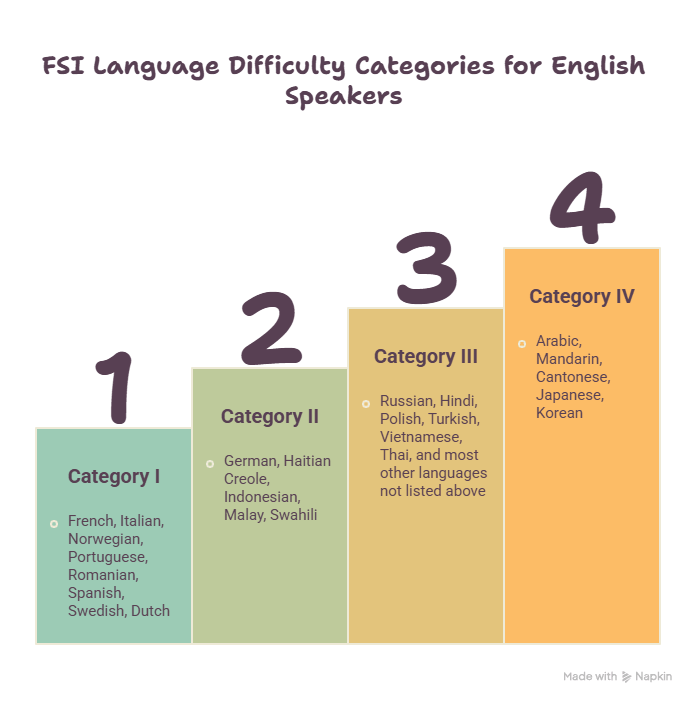
Yes, and most guides skip this entirely. The Foreign Service Institute groups languages into four categories based on how long it takes a native English speaker to reach professional speaking proficiency:
FSI Category | Class Hours to Proficiency | Example Languages |
|---|---|---|
I | 552-690 | French, Italian, Norwegian, Portuguese, Romanian, Spanish, Swedish, Dutch |
II | ~828 | German, Haitian Creole, Indonesian, Malay, Swahili |
III | ~1,012 | Russian, Hindi, Polish, Turkish, Vietnamese, Thai, and most other languages not listed above |
IV | 2,200 | Arabic, Mandarin, Cantonese, Japanese, Korean |
This means the same amount of daily practice produces visibly faster level jumps in a Category I language than in a Category III or IV one. I went from Danish, a native language, into Dutch and French as a young adult, both a relatively short jump, and progress felt fast. Italian, despite being closer to French than Mandarin is to English, still took noticeably longer to feel automatic, because it was my first real jump away from the Germanic language family I grew up thinking in. If you’re learning a Category III or IV language, expect your CEFR or ACTFL level to move more slowly for the same monthly effort, and don’t mistake that slower curve for a lack of progress.
For the full hour-by-hour breakdown behind these category numbers, how long it actually takes to learn a foreign language lays out the FSI data in more detail.
What to Avoid When Judging Your Own Progress
Don’t compare yourself to a native speaker. Native fluency is not the goal most learners actually need, and measuring against it makes real progress look like failure. Don’t judge progress by vocabulary size alone, since passive recognition and active speaking vocabulary grow at different speeds. And don’t set a fluency timeline based on someone else’s language pair. A Category I language and a Category IV language simply do not move at the same speed, no matter how motivated you are.
Tools That Can Track This For You
If you’d rather not run a spreadsheet by hand, a handful of apps now build self-assessment and level tracking directly into the practice itself. For a closer look at which apps actually do this well, language assessment apps built for progress tracking breaks down the strongest options.
A few more useful guides:
- Why Do I Translate in My Head? Causes & Easy Fixes Now
- Lingoda vs Preply: Which Fits Your Learning Style?
- How to Fix Pronunciation Problems (Not Your Accent)
Conclusion
Measuring progress in speaking a new language works best as two tracks running side by side: an informal check every few weeks (recording, duration, topic range) and a formal CEFR or ACTFL self-assessment every few months. Neither one alone tells the whole story, and how fast either one moves depends heavily on which language you’re learning.
Start today: record yourself talking for 2 minutes on a familiar topic. That recording is your baseline. Everything you compare against it from here counts as proof.
Frequently Asked Questions
How long does it take to become fluent?
It depends entirely on the language’s FSI category and your weekly hours, ranging from roughly 552 hours for a Category I language to 2,200 for a Category IV one. “Fluent” also means different things to different people, so define your target level first.
What is the best way to measure language proficiency?
Combine a formal scale (CEFR or ACTFL) with an informal monthly recording. The formal scale gives you an objective level; the recording catches week-to-week changes the scale is too coarse to show.
Can I trust an app’s proficiency score?
Use it as a rough signal, not a certificate. Most app scores aren’t independently validated against CEFR or ACTFL criteria, so treat them the way you’d treat a practice quiz, useful for direction, not proof.
Does watching shows or listening count as speaking progress?
It builds the comprehension that speaking depends on, but it doesn’t train production directly. Passive input needs to be paired with actual speaking practice to show up in your speaking level.
What if I feel stuck at the same level for months?
Check your informal signals (conversation length, hesitation count, topic range) before assuming you’ve plateaued. Formal levels move in large jumps, so you can be improving steadily in between two CEFR checkpoints without any single test showing it.