
How Long Does It Take to Learn a Foreign Language?
Quick Summary
▸The U.S. Foreign Service Institute (FSI) estimates 552-690 class hours to reach professional working proficiency in Category I languages (Spanish, French, Italian, Portuguese)
▸FSI’s program runs 40 hours per week, not the 30 minutes a day most people actually manage
▸At 1 hour of daily study, 600 hours takes nearly two years, not six months
▸Category IV languages (Arabic, Mandarin, Japanese, Korean) require approximately 2,200 class hours under the same conditions
▸Functional working proficiency (CEFR B2) typically requires roughly half the hours needed for professional fluency (C1)
▸Immersion in a target-language country accelerates spoken fluency and vocabulary acquisition significantly faster than classroom study alone
▸The single biggest variable is not the language. It is daily consistency of meaningful exposure
Here is the number everyone quotes: 600 hours to learn Spanish. Here is what nobody mentions: that figure comes from the Foreign Service Institute, whose students study 40 hours per week with a personal tutor, structured curriculum, and zero distractions. At 30 minutes a day, 600 hours takes over three years.
That gap, between what the data says and what it actually means for a real person, is why so many learners feel like they’re failing when they’re not. They’re measuring themselves against a timeline designed for full-time diplomats, not for people learning a language alongside a job, a family, or a new life in a foreign country.
This guide gives you the honest version. You’ll get the official FSI and CEFR data in plain language, a realistic picture of what immersion does and doesn’t accelerate, and a specific answer to the question most language learners actually need: how long until you can work and live in this language, not just pass a formal exam.
What Does “Learning a Language” Actually Mean?
The answer depends entirely on what you mean by “learned.” There is no single definition of fluency, and your target level determines your timeline more than the language itself does.
Most serious frameworks use the CEFR scale (Common European Framework of Reference for Languages), which runs from A1 (complete beginner) to C2 (near-native mastery). The distinction that matters most for practical purposes is between functional fluency, roughly B1 to B2, where you can work, live, and communicate effectively and professional or academic fluency at C1 and above.
For the majority of learners, including the expats and work-relocated professionals who make up a significant portion of language learners in structured courses, B2 is the real finish line, not C2.
How Long Does It Take to Reach Each CEFR Level?
The table below shows approximate cumulative guided learning hours from zero for a Category I language (Spanish, French, Italian, Portuguese, Dutch). These are starting reference points, not guarantees.
CEFR Level | What You Can Do | Approx. Hours from Zero |
|---|---|---|
A1 | Basic greetings, simple questions | 60–100 hours |
A2 | Everyday routines, simple transactions | 150–200 hours |
B1 | Travel, work basics, familiar topics | 300–350 hours |
B2 | Professional communication, most daily situations | 500–600 hours |
C1 | Complex topics, near-fluent conversation | 700–800 hours |
C2 | Near-native, academic and literary register | 1,000+ hours |
For full CEFR and FSI comparison tables including harder language categories, this guide to choosing a language learning method covers the complete breakdown with proficiency level analysis.
How Long Does It Take to Learn a Foreign Language? The Baseline Numbers
For English speakers, Category I languages take 600–750 class hours to reach professional working proficiency under FSI conditions. Category IV languages (Arabic, Mandarin, Japanese, Korean) require approximately 2,200 hours.
The part that changes everything: FSI defines its program as 23 hours of in-class instruction plus 17 hours of daily self-study, a 40-hour study week. These are not hours you accumulate over years of evening practice. They assume language learning is your full-time job.
The part that changes everything: FSI defines its program as 23 hours of in-class instruction plus 17 hours of daily self-study, a 40-hour study week. These are not hours you accumulate over years of evening practice. They assume language learning is your full-time job.
FSI Language Categories at a Glance
FSI Category | Example Languages | Class Hours | At FSI Pace | At 1 Hour/Day |
|---|---|---|---|---|
I (Easiest) | Spanish, French, Italian, Portuguese, Dutch | 552-690 | 24–30 weeks | ~2 years |
II | German, Indonesian, Malay, Swahili | ~828 | 36 weeks | ~2.5 years |
III | Hebrew, Finnish, Russian, Thai, Vietnamese | ~1,012 | 44 weeks | ~3 years |
IV (Hardest) | Arabic, Mandarin, Japanese, Korean | 2,200 | 88 weeks | ~6 years |
The FSI’s 600-hour estimate for Spanish assumes 40 hours of study per week. At 1 hour per day, that same milestone takes closer to two years. Knowing which pace you’re actually on changes everything about how you measure progress.
What Factors Most Affect How Long It Takes?
The two biggest variables are linguistic distance from your native language and the amount of daily meaningful exposure you accumulate. Everything else, age, talent, apps, modifies around those two.
- Linguistic distance. Spanish is faster for English speakers than Mandarin because the alphabet, vocabulary roots, and sentence structure are closer. FSI’s category system is built entirely on this principle.
- Daily consistency. Research consistently shows that frequent, shorter sessions outperform occasional long ones for retention. Thirty focused minutes daily beats a three-hour weekend session.
- Prior language experience. If you already speak a Romance language, French comes faster. Your brain has existing frameworks to attach new patterns to.
- Age. Adults actually acquire vocabulary and grammar faster than children in the early stages. Children eventually surpass adults in accent and long-term nativelikeness, but the “children learn faster” belief is largely a myth for initial acquisition.
- Motivation and purpose. Learners with a concrete, immediate goal, a job, a relationship, a relocation, progress faster than those studying without a specific context. The reason is simple: purposeful daily use accelerates exposure in ways no app can replicate.
- Learning method. Immersion, structured classes, self-study apps, and one-to-one tutoring all produce different results at different speeds, covered in the next two sections.
How Long Until You Can Work and Live in This Language?
Most learners reach functional B1–B2 competence in roughly half the hours required for C1 professional fluency, meaning approximately 300–500 hours for a Category I language rather than 600–750. This is the question most language learning content ignores entirely, because it’s aimed at general learners rather than people with a real deadline.
If you’ve been relocated for work, if you’re an expat navigating daily life in a foreign country, or if you need the language to hold meetings rather than pass a DELF exam, your target isn’t C1. Your target is the point where the language stops costing you energy. That’s typically a solid B2 and it arrives meaningfully earlier than the FSI numbers suggest.
During Lingoda group classes taken as part of ongoing research for this site, the clear majority of students were already living abroad for work purposes or needed the language professionally. Their question was never “when will I be fluent?” It was: “when can I stop exhausting myself every time I open my mouth?” That is a B2 question, and it has a much shorter answer.
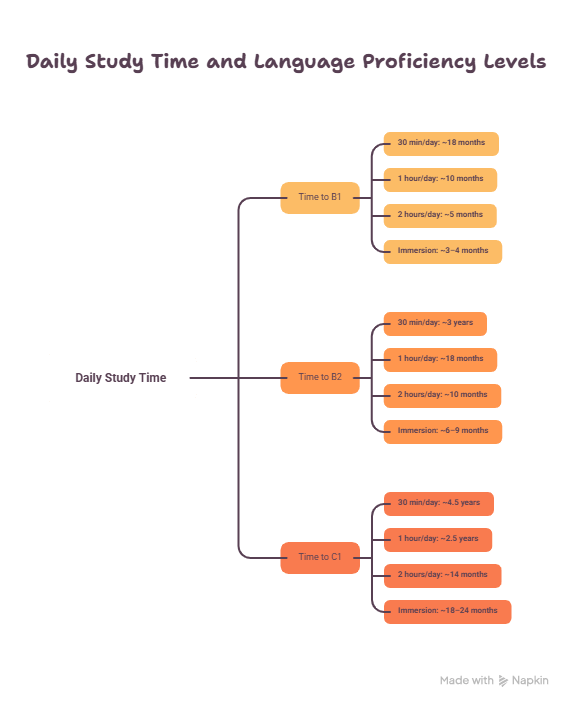
How Long to Functional Fluency at Different Study Intensities (Category I Language)
Daily Study Time | Time to B1 (Survival) | Time to B2 (Functional) | Time to C1 (Professional) |
|---|---|---|---|
30 min/day | ~18 months | ~3 years | ~4.5 years |
1 hour/day | ~10 months | ~18 months | ~2.5 years |
2 hours/day | ~5 months | ~10 months | ~14 months |
Immersion (abroad, full exposure) | ~3–4 months | ~6–9 months | ~18–24 months |
Why Functional Fluency Arrives Faster Than the Hour Counts Suggest
Language acquisition is not linear. Research on proficiency development shows learners advance quickly from A1 through B1, then progress slows noticeably as the language becomes more complex and less rule-bound. The plateau many learners hit around B1 is not failure, it is documented, normal, and temporary.
For work-abroad learners specifically, this matters because the practical payoff arrives early. Navigating a bureaucracy, following a meeting, shopping without switching to English, all of this is achievable at B1 to B2. The long tail toward C1 and C2 is where formal study investment continues, but daily life becomes manageable long before that point.
For many learners living abroad, the barrier to functional fluency is not hours logged. It is confidence. This covers the specific anxiety patterns that stall speaking progress and what actually resolves them.
Does Immersion Speed Up Language Learning?
Yes, meaningfully! immersion in a target-language country accelerates spoken fluency and vocabulary acquisition faster than classroom-only study. Research tracking learners before, during, and after stays abroad shows consistent improvements in oral fluency, lexical range, and pragmatic appropriateness, the ability to say the right thing in the right way in real social contexts.
But immersion is not magic, and it does not do everything.
What Immersion Actually Does (and Doesn’t Do)
Immersion accelerates specific skills faster than any structured course:
- Listening comprehension improves rapidly because real-world speech is faster, less formal, and more varied than classroom audio
- Spoken fluency and natural phrasing develop through constant low-stakes repetition, ordering coffee, asking directions, small talk with neighbours
- Vocabulary in context builds faster when words are attached to real experiences rather than flashcard lists
- Pragmatic competence knowing how to be polite, casual, or assertive in a given situation, is almost impossible to teach in a classroom and arrives naturally through exposure
What immersion does not automatically improve:
- Grammatical accuracy. You can become highly fluent while still making the same grammatical errors you made in month two. Daily life does not correct your subjunctive
- Formal written register. Living abroad teaches you to speak. It does not teach you to write a formal email or a business report
- Reading literacy. You need to actively read, menus and street signs don’t count
Living in a country, you don’t count study hours. Exposure is constant and unstructured. The FSI model of accumulating measurable hours breaks down completely under ambient immersion, which is why the immersion row in the table above shows faster results than hour-counting alone would predict, and why formal acquisition research distinguishes sharply between target-language-context learning and classroom learning.
If you find you understand the language around you but freeze when it’s your turn to speak, this explains exactly why that gap exists and how to close it.
Immersion vs. Apps and Online Classes
Apps and online tutoring platforms are not immersion. They are structured simulations of the communicative practice that immersion provides naturally. For people who cannot relocate, they are the best practical proxy available. For people already living abroad, they fill the structured grammar and accuracy gap that ambient daily exposure alone does not cover.
The most effective learners living in a foreign country are not the ones relying on immersion alone. They are the ones pairing daily-life exposure with structured practice that targets what real life does not teach. In Lingoda group classes, the students already living abroad were using structured sessions to build the grammatical precision and formal register their daily routines were never going to give them on their own.
Choosing the right method determines your timeline more than almost any other single decision, this guide to choosing a language learning method walks through the evidence behind each approach and how to match method to goal.
How Much Do You Need to Study Each Day?
Consistency outperforms intensity. Daily engagement, even 30 focused minutes, produces better retention than longer sessions spread across a week. The research explanation is straightforward: spaced repetition requires regular intervals. A three-hour session on Sunday does not replace seven 25-minute sessions.
For people living abroad, the “how much do I study?” question gets complicated. If you’re surrounded by the language all day, does ambient exposure count? Partly. Passive exposure hearing conversations, watching TV, overhearing colleagues, builds comprehension and natural phrasing over time. Active engagement, speaking, writing, working through grammar, being corrected, is what drives accuracy and accelerates the timeline.
The practical formula for work-abroad learners: let daily life handle passive exposure, and protect 30–60 minutes for structured active practice. That combination consistently outperforms either approach alone.
A structured daily routine is the fastest way to make those hours add up, this speaking practice framework shows exactly how to build one that holds.
The Biggest Myths About How Long It Takes
Most timeline frustration traces back to five persistent myths, each of which sets expectations that real acquisition simply does not match.
- “You can become fluent in 3 months.” Conversational competence in a Category I language is achievable in 3–6 months under intensive immersion conditions. Stable, reliable fluency across varied contexts is not. Apps and courses that promise otherwise are selling the exception as the rule
- “Children learn faster than adults.” Adults acquire vocabulary, grammar rules, and conversational structure faster than children in the early stages. Children eventually surpass adults in accent authenticity and long-term nativelikeness. The myth persists because we observe children becoming fluent over years while forgetting they had years of daily full-immersion exposure to get there.
- “Immersion alone is enough.” As covered above, immersion accelerates speaking and listening. It does not automatically build grammatical accuracy, formal writing, or reading skills. Learners who rely on immersion alone often plateau at a fluent but imprecise B2
- “The FSI hours apply to me.” They apply to a diplomat studying 40 hours per week with a private tutor and no competing demands. At 1 hour per day, multiply every FSI estimate by roughly four
- “If I’m not progressing, I’m doing it wrong.” The B1 plateau is the most documented phenomenon in second language acquisition research. Progress slows sharply after initial gains because the remaining gaps are subtler and harder to fill. Slower is not stopped
Worth Reading Next
- How Study Abroad Deepens Language Learning Skills, the cognitive and social mechanisms behind why living in a country changes your relationship with a language
- Lingoda Review: Is It Worth Your Time and Money? my honest look at whether structured group classes deliver on the immersion promise for working adults and expats
The Honest Answer
How long it takes to learn a foreign language depends on three decisions you make before you open a textbook: what level you actually need, which language you’re learning, and how many minutes per day you can protect for deliberate practice.
The FSI data is real and worth knowing. So is the caveat that it was never designed for you. Diplomats study full-time in controlled conditions. You are learning alongside a life, possibly while already living in the country, navigating work and daily routines in a language you’re still building.
That context does not slow you down as much as you might think. The expats and relocated professionals who progress fastest are not the ones with the most natural talent. They are the ones who stopped waiting to feel ready and started accumulating exposure, structured and unstructured, daily and deliberate.
Pick your target level. Work backwards to a daily time commitment you can actually sustain. Then measure progress against your own baseline, not against an FSI table built for a 40-hour study week..
The timeline is longer than the apps suggest and shorter than the myths imply. That is the honest answer.
Frequently Asked Questions
How long does it take to learn a language if you study 30 minutes a day?
For a Category I language like Spanish or French, 30 minutes of focused daily study will typically get you to B1 (survival fluency) in around 18 months and B2 (functional fluency) in approximately 3 years. That timeline assumes active, structured study rather than passive listening, the quality of the 30 minutes matters as much as the consistency.
Is it harder to learn a language as an adult?
Adults actually acquire vocabulary and grammar faster than children in the early stages of learning. What adults find harder is reaching a native-like accent, and they typically need more deliberate practice to match the long-term fluency children eventually develop through years of immersive exposure.
How long does it take to reach B2 in a foreign language?
For a Category I language studied at 1 hour per day, B2 takes approximately 18 months. Under full immersion conditions, living and working in the target language country, the same level is reachable in 6–9 months for most learners. B2 is the level at which most people can handle professional communication and daily life without significant difficulty.
Can you become fluent without living abroad?
Yes. Living abroad accelerates spoken fluency and vocabulary range, but it is not required. Consistent structured study combined with regular conversation practice, through tutors, language partners, or structured group classes, produces comparable results over a longer timeline. The key variable is the amount of meaningful output practice, not the postcode.
How long does it take to learn a language for work purposes?
For most professional contexts, B2 is the functional target: you can follow meetings, communicate with colleagues, and handle formal emails. For a Category I language, B2 is achievable in 10–18 months at 1 hour of daily study, or 6–9 months under immersion conditions. If your work requires presenting, negotiating, or writing formal documents, aim for C1 and add another 12 months to those estimates.