Spaced Repetition vs Traditional Learning: Which Works?
TL;DR
Spaced repetition outperforms traditional methods for vocabulary retention. Research across 317 experiments shows it beats cramming by 10–30%, and a 2025 study of 26,258 learners found SRS groups retained 34% more material. Traditional methods still lead on grammar and speaking fluency. AI now removes the three biggest friction points that cause learners to quit SRS. The strongest results come from combining all three: SRS for vocabulary, traditional input for grammar and fluency, and AI to close the gaps between them.
Here is something worth knowing before you open another flashcard app: without deliberate review, you will forget approximately 67% of everything you learned today by tomorrow.
That number comes from Hermann Ebbinghaus’s forgetting curve research, first published in 1885 and replicated under modern conditions in 2015 with results that closely matched the original data. The curve is real, it is steep, and it does not care how motivated you are.
This is the problem that spaced repetition (SRS) was designed to solve. But it is also where the debate gets interesting, because most language learners treat SRS and traditional learning as an either/or choice. They commit fully to apps, or fully to classes. Both camps leave results on the table.
This post breaks down what the research actually says, how AI is changing the SRS workflow in ways most learners have not caught up with yet, and what a practical 30-day hybrid system actually looks like.
What Is Spaced Repetition (and How Is It Different from Normal Studying)?
Spaced repetition is a study method that schedules each review session at the precise moment your memory of a piece of information starts to fade. Instead of reviewing everything on a fixed timetable, or cramming it all at once, SRS software tracks how well you recalled each item and uses that data to push the next review further and further into the future as your memory strengthens.
The underlying mechanism is the spacing effect: reviewing material spread across time produces significantly better long-term retention than reviewing the same amount of material in a single block. This is not intuitive, which is why most people default to cramming. Cramming feels productive because you can tell it is working in the moment. The problem is that it is not working two weeks later.
How the SM-2 Algorithm Actually Works
The algorithm that powers most SRS tools today is SM-2, developed by Piotr Woźniak at SuperMemo in 1987. The SM-2 algorithm reviews a new card after day 1, then day 6, then multiplies the interval by an “ease factor” (default: 2.5) after each successful recall. A card you find easy might jump from 6 days to 15 days to 38 days. A card you keep forgetting stays on a short cycle until it sticks.
Anki runs a modified SM-2 alongside a newer algorithm called FSRS — both serve the same function: showing you the right card at the right time.
Our guide on how spaced repetition builds vocabulary fast , explains in-depth the forgetting curve, active recall, and long-term retention.
What Counts as “Traditional” Language Learning?
Traditional language learning covers any method that does not rely on algorithmically scheduled review. That includes classroom instruction, textbook study, grammar drills, audio courses like Pimsleur, conversation practice with a tutor or native speaker, and immersion environments.
This is important to define clearly, because “traditional” is not a synonym for “bad.” Research found that classroom learning is particularly effective for beginners, specifically because it provides explicit grammar instruction, a progressive curriculum, and structured feedback that self-directed learners frequently miss.
Traditional methods consistently outperform SRS in three areas:
- Grammar acquisition — understanding rules and their exceptions requires explanation, not flashcards
- Speaking and pronunciation — these need real-time feedback that no app currently replicates well
- Contextual comprehension — reading and listening in context builds fluency that isolated word-pair drilling cannot
The honest summary: traditional learning builds the scaffolding. SRS fills in the vocabulary faster than anything else.
Does Spaced Repetition Work for Language Learning?
Yes, and the evidence is very strong. A 2024 study tracked 74 Japanese university EFL learners over two academic semesters. The SRS treatment group significantly outperformed the control group in total vocabulary score gains across three dimensions: meaning, form, and use.
The reason SRS works particularly well for vocabulary is structural. Vocabulary items are discrete and retrievable — you either know a word or you do not, which makes them ideal targets for flashcard-style retrieval practice. Grammar rules and speaking fluency involve too many variables for a simple right/wrong card system to handle effectively.
Is Spaced Repetition Really Necessary — Or Can You Just Study More?
The research says the timing of review matters more than the amount of review. A landmark meta-analysis by Cepeda et al. (2006), covering 317 experiments on distributed practice, found that spaced practice consistently outperformed massed practice by 10–30% across all study types and age groups. Studying more does not close that gap if the review timing is wrong.
Roediger and Butler (2011) showed that retrieval practice combined with spacing reduces forgetting by up to 80% over one week compared with restudying. For language learners, this plays out predictably: study 200 words in a single afternoon session and you will feel confident. Come back three days later without a review, and most of those words are gone. The learner who reviewed 40 words per day across five days with SRS-timed repetitions will consistently outperform you on a two-week retention test.
Spaced Repetition vs Traditional Learning: Which Should You Use?
The research does not support choosing one over the other. It supports combining them, with SRS handling vocabulary and traditional methods handling everything else.
Here is a simple decision framework:
Use SRS when you need to:
- Build and retain a large vocabulary quickly
- Review material you have already been taught
- Study independently with limited time per session
- Maintain a language you are not actively using
pick one SRS tool — the best options for your level are here
Use traditional methods when you need to:
- Understand grammar rules and sentence structure
- Develop speaking fluency and pronunciation
- Build listening comprehension from real-world input
- Reach B2 level and beyond, where vocabulary alone is not enough
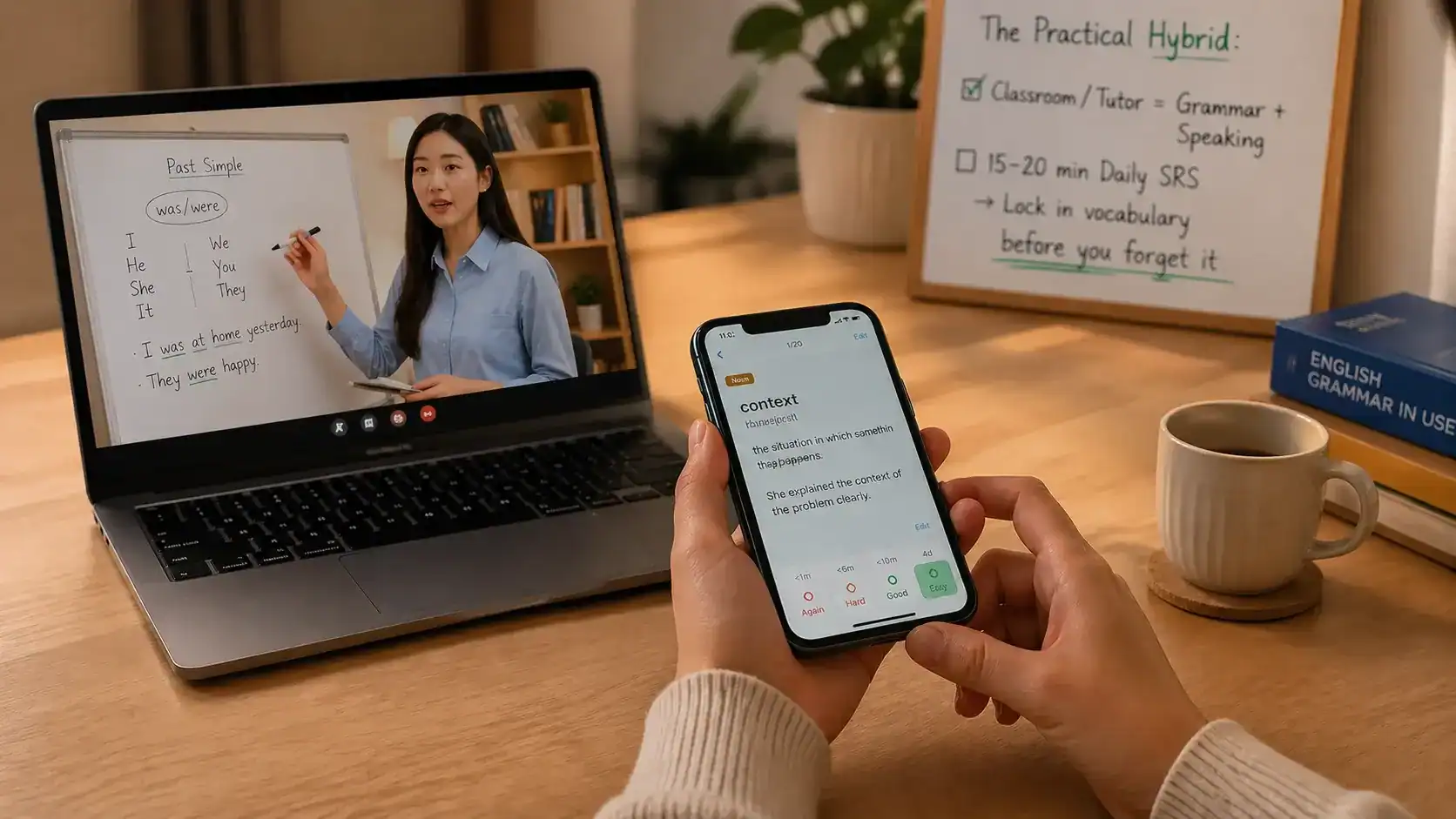
The practical hybrid: Use your classroom time or tutor sessions for grammar and speaking. Use 15–20 minutes of daily SRS to lock in the vocabulary from those sessions before you forget it. According to AI vocabulary learning best practices, adding new words to an SRS deck immediately after encountering them in context is significantly more effective than reviewing decontextualised word lists.
How AI Changes the SRS Equation (and Why No One Is Talking About It)
AI does not replace spaced repetition. It removes the three biggest reasons people quit it. The traditional SRS workflow has a friction problem: you have to find vocabulary worth learning, create cards that are actually useful, and then trust that reviewing isolated word pairs will eventually produce fluency. AI collapses all three steps.
Here is what that looks like in practice:
Card creation: The most common reason learners abandon Anki is the time it takes to build a quality deck. A well-structured card includes the target word, an example sentence in context, a pronunciation note, and ideally a memory hook. Building that manually for 15 words takes 20–30 minutes — longer than the review session itself. With a tool like ChatGPT or Claude, you paste a list of words from your tutor session or reading material and prompt: “Create Anki-ready flashcards for these 15 words in [target language]. Include: target word, English translation, one natural example sentence, and a memory tip based on etymology or a cognate where possible.” Card creation drops to under two minutes.
Sentence context: Pure word-pair cards (word → translation) are the weakest form of SRS. The research consistently shows that vocabulary learned in sentence context transfers better to real use. AI tutors like Clozemaster generate unlimited contextual practice sentences on demand, at your exact level, in your target language. You are no longer drilling “hola = hello.” You are reviewing “hola” in three different conversational contexts, each one slightly harder than the last.
Adaptive difficulty: Standard SRS schedules repeat cards based on recall success or failure. They do not know whether you are struggling because the word is hard or because the card is poorly written. AI can audit your deck, identify cards with low recall rates, and rewrite them with better context, clearer prompts, or stronger memory hooks.
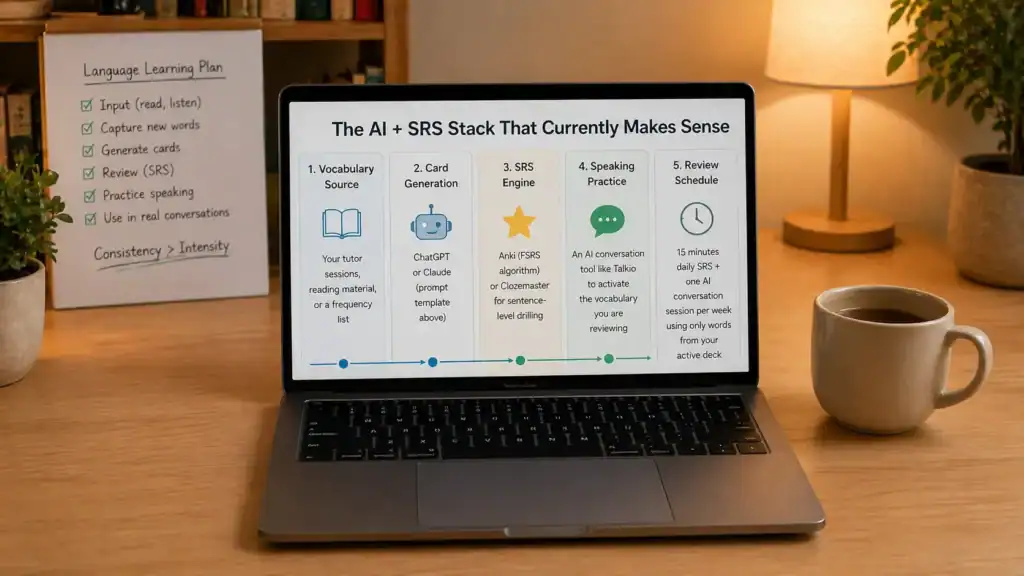
The AI + SRS stack that currently makes sense:
- Vocabulary source: Your tutor sessions, reading material, or a frequency list
- Card generation: ChatGPT or Claude (prompt template above)
- SRS engine: Anki (FSRS algorithm) or Clozemaster for sentence-level drilling
- Speaking practice: An AI conversation tool like Talkio to activate the vocabulary you are reviewing
- Review schedule: 15 minutes daily SRS + one AI conversation session per week using only words from your active deck
Your First 30 Days: A Practical SRS + Traditional Hybrid System
The question you want the answer to is: what do you actually do on Monday morning? Here is a concrete 30-day system that combines SRS with traditional methods, requires no more than 25 minutes per day, and is designed to build a sustainable habit before adding complexity.
Week 1: Foundation (Days 1–7)
The goal this week is not progress. It is establishing the review habit before you add any volume.
- Tool: Download Anki (free, desktop or mobile) or another SRS tool that suits your style.
- Cards: Add exactly 10 new cards per day. Source them from one consistent place: a beginner frequency list, your textbook chapter, or words from your first tutor session.
- Card format: Front: target word + a short example sentence. Back: translation + pronunciation note. No audio yet, no images — keep the setup cost near zero.
- Daily session: Reviews first (takes 2–5 minutes in week 1), then new cards. Total: under 15 minutes.
- Traditional complement: One 30-minute session this week with a tutor, italki teacher, or structured lesson. Focus on pronunciation and basic grammar scaffolding.
Week 2: Context Layer (Days 8–14)
You now have 70 cards in rotation. The habit is forming. Add context.
- Upgrade your cards: When adding new cards, include one AI-generated example sentence using the prompt format above. Start rewriting your weakest week-1 cards the same way.
- Increase to 15 new cards per day only if your daily review session is staying under 20 minutes. If reviews are already eating time, stay at 10.
- Add one reading or listening session per week in your target language. When you encounter a word from your Anki deck, note it. That recognition moment is what transfers SRS drilling into real-world fluency.
Week 3: Speaking Activation (Days 15–21)
Passive recall and active production are different skills. This week bridges them.
- Add one AI speaking session per week. Use Talkio or a similar AI conversation tool. Before the session, export your 20 most-reviewed Anki words and tell the AI to use them in the conversation.
- Maintain 15 cards per day. Your review load is now 100–150 cards total. Sessions should run 15–20 minutes.
- Track one metric only: your Anki “retention rate” (the percentage of cards you answer correctly). Aim for 85–90%. Below 80% means your cards are too hard or you are adding too many. Above 95% means your intervals are too short and you are over-reviewing easy material.
Week 4: Calibration (Days 22–30)
By day 30 you have approximately 210 words in active rotation, a measurable retention rate, and a daily habit that runs on autopilot.
- Review your weakest 20 cards. Rewrite any that have a consistent fail rate — the problem is almost always the card, not your memory.
- Decide your sustainable daily volume. Most learners settle between 10 and 20 new cards per day long-term. Pick a number you can maintain for six months, not the number that feels ambitious today.
- Add one traditional input source. A podcast in your target language, a TV series on Netflix with subtitles, or a graded reader all work well here. The vocabulary you are drilling in Anki will start appearing, and that recognition loop is what makes SRS feel like it is finally working.
The single most important SRS rule
Do your reviews before adding new cards.
Every day.
Missing new cards sets you back a day.
Missing reviews creates a backlog that compounds and kills the habit.
Conclusion
The science is not ambiguous. Spaced repetition is the most efficient method available for building and retaining vocabulary, and the evidence base behind it is among the strongest in cognitive psychology. If you are learning a language and not using SRS, you are leaving retention on the table.
But SRS is not a complete language learning system. It does not teach you grammar. It does not make you fluent. And without AI to handle card creation, it has a setup cost that causes most learners to quit within a month. The learners who get the best results treat SRS as one component of a deliberate system: vocabulary drilling via SRS, grammar and pronunciation via structured traditional input, and AI to bridge the two by generating contextual cards and activating vocabulary in real conversation.
The 30-day framework above is the starting point. The goal in month one is not fluency — it is a daily review habit and a calibrated card volume you can sustain. Everything else compounds from there.
Frequently Asked Questions
How long does it take to see results from spaced repetition in language learning?
Most learners notice meaningful vocabulary retention improvements within two to four weeks of consistent daily practice. The key variable is consistency: 15 minutes every day outperforms 90 minutes twice a week.
Can I use spaced repetition for grammar, not just vocabulary?
Yes, but with caveats. SRS works well for grammar patterns that can be expressed as a sentence-translation pair — for example, a card showing “She has been waiting” on one side and the Spanish equivalent on the other. It works less well for understanding why a rule exists or when to use it. Use SRS to drill patterns you have already understood through instruction, not to learn grammar from scratch.
How many new words should I add to my SRS deck per day?
Research and practitioner consensus point to 10–20 new words per day as the sustainable range for most learners. At 10 words per day, you add approximately 300 words per month. At 20 words per day, 600 per month. The B1 level in most languages requires roughly 2,000–3,000 words, which means a consistent 15-word-per-day habit gets you there in 4–6 months. The bigger risk is adding too many and creating a backlog that makes daily review feel unmanageable.
Is spaced repetition good for ADHD learners?
Yes, and the structure suits ADHD learners particularly well. Research published in PMC (2024) found that ADHD learners benefit significantly from shorter, more frequent study sessions rather than longer continuous blocks — exactly the pattern SRS produces. Sessions are short, focused on a small set of items, and end with a clear stopping point. In Anki specifically, setting a strict daily new card limit (10 maximum) prevents the common ADHD trap of adding cards aggressively then abandoning the app when the review backlog becomes overwhelming.