Daily Language Speaking Practice Routine
Quick Summary
▸Category I languages (Spanish, French) need 552-690 class hours to reach professional proficiency
▸Shadowing practice produced measurable gains in speech rate and pronunciation in a controlled study of 40 EFL students
▸Output, not just input, is essential for fluency.
▸Target routine for steady progress: 20-30 minutes daily
▸Minimum viable routine: 5 minutes (review plus 3 spoken sentences)
▸A 30-second starter routine is included below. No app and no partner required
I track AI language learning tools and their real-world effectiveness, and the one pattern that shows up again and again: people who speak daily, even badly, improve faster than people who study grammar for an hour and never open their mouth.
The Foreign Service Institute trains U.S. diplomats in over 70 languages, and their data shows Spanish or French takes 600 to 750 class hours to reach professional proficiency. That’s the official number. What it doesn’t tell you is how to structure your 20 minutes tonight after work. Most advice online stops at “practice every day” and leaves you there.
How fast you progress depends heavily on what you’re measuring this guide to realistic language learning timelines explains what fluency milestones actually look like and when to expect them.
This guide gives you the actual routine: a 30-second starting point, a time-based schedule you can pick based on how busy your day is, ready-to-use prompts, and a way to tell if any of it is working.
What’s the fastest way to start a daily speaking practice routine?
Say three sentences out loud about your day, in your target language, right now, before you do anything else. That’s the entire 30-second routine.
It doesn’t matter if you mess up the grammar. The point is breaking the silence habit: the thing where you understand a language but freeze the moment you need to produce it. Most learners spend months in “input mode” (reading, listening, app lessons) and almost no time actually talking. The 30-second version exists so there’s zero excuse to skip a day.
If you only do one thing from this entire post, do this. Three sentences, out loud, every single day, before you check your phone for anything else.
What should a daily language speaking practice routine include?
A complete routine has four parts: a warm-up review, active speaking output, a listening or shadowing block, and a quick self-check. Skip any one of these for too long and progress stalls in a specific, predictable way.
Warm-up review means pulling up notes or vocabulary from your last session, just enough to wake up your memory. Active output is where you actually produce language: talking to yourself, a partner, or an AI tool. The listening block trains your ear and feeds your output with new patterns. The self-check is where most people quit too early, but it’s how you know if today’s 10 minutes actually did anything.
If solo practice starts to feel like a ceiling rather than a stepping stone, our comparison of the best tutoring platforms breaks down which ones are actually worth the cost for regular speaking feedback.
How long should you practice speaking a foreign language each day?
For conversational fluency, aim for 20-30 minutes of daily active practice, with real speaking included, not just listening or flashcards. The reasoning isn’t just intuition: research on Canadian French immersion students found that years of rich listening and reading input produced near-native comprehension, but speaking ability lagged far behind, because input alone never forced these students to produce language. Less than that still helps; more than that has diminishing returns unless you’re prepping for an exam.
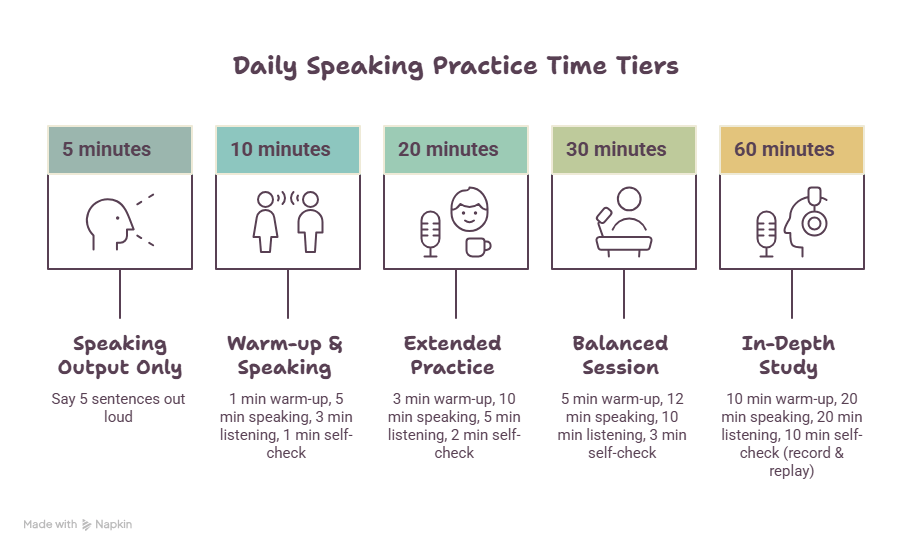
Here’s how to scale the routine to your actual schedule:
Time | Warm-up | Speaking output | Listening/shadowing | Self-check |
|---|---|---|---|---|
5 min | Skip | Say 5 sentences out loud | Skip | Skip |
10 min | 1 min | 5 min | 3 min | 1 min |
20 min | 3 min | 10 min | 5 min | 2 min |
30 min | 5 min | 12 min | 10 min | 3 min |
60 min | 10 min | 20 min | 20 min | 10 min |
A busy week doesn’t have to break the habit. Drop to the 5-minute tier and keep going rather than skipping entirely. Consistency beats intensity here, and a missed week is harder to recover from than a string of short, imperfect sessions.
How can I practice speaking a foreign language by myself?
The three most effective solo methods are shadowing, self-narration, and recorded self-review. None of them require another person in the room.
Shadowing means listening to a native speaker and repeating what they say almost simultaneously, copying their rhythm and intonation, not just the words. Self-narration is talking through whatever you’re doing right now, out loud, in your target language (“I’m making coffee, the water is boiling”). Recorded self-review means recording yourself speaking for two minutes and listening back the next day, which catches mistakes your ear misses in real time.
What is shadowing and does it actually work?
Shadowing is repeating spoken audio aloud in real time, matching the speaker’s pace and intonation rather than translating or pausing to think. A controlled study of 40 university EFL students found the shadowing group showed significant gains in listening accuracy, speech rate, and pronunciation, while the control group following a normal curriculum improved only 3-5% on the same measures.
The technique started in the 1950s as a research tool for studying the gap between hearing and speaking, built by Soviet researchers Ludmilla Chistovich and Valerij Kozhevnikov. It’s been used in interpreter training ever since, which tells you something about how seriously it’s taken once you get past beginner-level apps.
To shadow correctly: pick a short audio clip (30-60 seconds), play it once to understand the gist, then play it again and speak along almost on top of the audio, not after it. Don’t pause to translate. If you fall behind, keep going rather than rewinding.
Can AI help me practice speaking daily?
Yes, and the specific advantage is judgment-free repetition at any hour. An AI conversation tool doesn’t get tired of correcting the same mistake for the fifth time, and it’s available at 11pm when no tutor is.
I’ve used a few of these tools myself, and the honest difference between them and a human partner is depth: AI handles drilling and low-stakes repetition well, but it still misses the natural back-and-forth unpredictability of a real conversation. Use it to fill the gaps between human sessions, not replace them entirely. If you’re deciding between AI practice, a paid tutor, or a language exchange partner, our full comparison of tutoring vs. exchange platforms lays out the tradeoffs in cost, structure, and accountability.
For tool-specific picks, our breakdown of AI Pronunciation Coach Tools walks through which ones actually catch real mistakes instead of just listening politely, and AI Language Tutors covers the stronger options for full conversation practice.
What are good daily speaking practice prompts?
Use prompts that match your level so you’re stretching, not freezing. Here are ten to rotate through:
Beginner
- Describe what you ate today, in three sentences.
- Name five things in the room and one thing you’d change about each.
- Give directions from your front door to the nearest shop.
Intermediate 4. Argue one small, low-stakes opinion (pineapple on pizza, best season of the year) for 60 seconds. 5. Retell a short news story you read today. 6. Describe a problem at work or school and how you solved it.
Advanced 7. Explain a concept from your job to someone with no background in it. 8. Compare two of your past travel experiences and what you’d do differently. 9. Argue both sides of a debate topic, switching positions halfway through. 10. Narrate a hypothetical situation: what would you do if you won a small lottery prize tomorrow.
How do I measure progress in a daily language speaking practice routine?
Record yourself speaking for two minutes once a week and compare it to last week’s recording, not to a native speaker. The clearest signs of progress are fewer pauses, faster recovery from mistakes, and more complex sentences attempted without giving up halfway through.
Grammar accuracy is the slowest-moving metric and the easiest to obsess over for no benefit. Fluency (the ability to keep talking without long silences) moves faster and matters more for real conversations.
For the fuller picture, including how often to run a formal CEFR or ACTFL check alongside this weekly recording, how to measure progress in speaking a new language walks through both tracks.
What’s the fastest way to improve speaking fluency?
Shift your practice time toward output instead of input. Most learners spend 80% of their study time listening or reading and 20% speaking, when the ratio that actually builds speaking fluency is closer to the reverse.
Common mistakes that slow down speaking progress
- Over-relying on passive listening. Podcasts and shows build comprehension, not the ability to produce language on demand.
- Skipping speaking out loud. Thinking sentences in your head doesn’t train the muscle memory or confidence that speaking aloud does.
- Perfectionism before output. Waiting until you “know enough” to speak means you never start; mistakes are part of the data, not a reason to delay.
- No feedback loop. Without a recording, tutor, or AI tool flagging errors, the same mistakes repeat indefinitely.
7-Day, 30-Day, and 90-Day Speaking Challenge
Days 1-7: Do the 30-second routine every single day, no exceptions. Add the 10-minute tier on weekends.
Days 8-30: Move to the 10 or 20-minute tier daily. Record yourself once at day 15 and once at day 30, and compare them.
Days 31-90: Hold the 20-30 minute tier at least 5 days a week. Add one new prompt category (intermediate or advanced) every two weeks. By day 90, compare your first recording to your most recent one.
Worth reading next
A few more useful guides:
- Why Can’t I Speak Despite Understanding
- How to Fix Fear and Anxiety When Speaking
- Speaking Practice Apps
- SRS vs Traditional Learning
Final Verdict
Pick one time tier from the table and start today, even if it’s just the 5-minute version. The data is clear that frequency beats intensity: daily 10-minute sessions build more usable speaking ability over a month than one 90-minute session a week. Start the 7-day challenge now, and add longer sessions only once the habit holds without effort.
Frequently Asked Questions
Is daily speaking practice necessary for language fluency?
Not strictly necessary, but it’s the fastest path. Learners who speak daily build the muscle memory for quick recall and natural pacing far faster than those who only study passively and speak occasionally.
Can you become fluent without a language partner?
Yes. Shadowing, self-narration, and AI conversation tools can take a self-study learner to a strong conversational level. A human partner accelerates progress but isn’t required to reach fluency.
How long until I notice improvement?
Most learners notice less hesitation and faster recall within 2-3 weeks of daily practice, even at just 10 minutes a day. Bigger jumps in fluency typically show up around the 30 to 60-day mark.
Should beginners speak from day one?
Yes. Waiting until you “know enough” delays the skill you’re actually trying to build. Beginners should speak simple, short sentences from their very first session, even with heavy mistakes.
What if I don’t have anyone to speak with?
Use shadowing, self-narration, and AI conversation tools to build the habit solo first. Many learners find it easier to start with a human partner only after a few weeks of solo practice removes the initial fear of speaking.