

How to Fix Pronunciation Problems (Not Your Accent)
Quick Summary
▸A 2025 study found that having a strong accent and being easy to understand are only weakly connected, so a strong accent doesn’t mean poor communication.
▸Not every mispronounced sound breaks communication: only the ones that shift meaning or obscure a word entirely.
▸A 2023 study found that learners whose native language is closely related to their target language pick up correct pronunciation faster, an advantage that shrinks the further apart the two languages are
▸The fix: find the specific sounds in your language pair that cause real misunderstanding, then drill those, instead of practicing every unfamiliar sound equally.
Most pronunciation advice starts from the wrong question. It asks: how do I sound more native? A 2025 study in Studies in Second Language Acquisition found something that should reframe that question entirely: how strong someone’s accent sounds and how easily people understand them are only weakly related. In plain terms: you can keep your accent and still be completely, easily understood.
This post covers how to fix pronunciation problems that genuinely interfere with communication, why some sounds are objectively harder to fix depending on your native language, and why chasing a native-sounding accent is the wrong goal in the first place.
The Four Types of Pronunciation Problems
Pronunciation problems fall into four categories: individual sound errors, word stress, sentence rhythm and intonation, and connected speech. Most learners assume it’s all one skill, but each of these breaks down differently and needs a different fix.
Individual sound errors happen when your mouth substitutes a sound from your native language for one that doesn’t exist there. Dutch speakers, for example, often struggle with the English “th” sound because neither language has it, and the tongue naturally falls back on a “d,” “z,” “t,” or “s” instead.
Word stress errors happen when the emphasis lands on the wrong syllable, which can change meaning entirely in some languages, or just sound noticeably off in others.
Rhythm and intonation errors are about the music of a sentence: which words get stressed, how pitch rises and falls, where pauses land. This is often what people mean when they say someone “has an accent,” even when every individual sound is technically correct.
Connected speech errors happen because natural speech blends words together (like “gonna” instead of “going to”), and learners who were taught word by word often speak too cleanly, in a way that sounds stilted rather than wrong.
Why Pronunciation Difficulty Depends on Your Native Language
Pronunciation is harder or easier depending on how far your native language’s sound system sits from your target language’s, a concept researchers call linguistic distance. The closer the two languages, the more your existing sound categories transfer over for free.
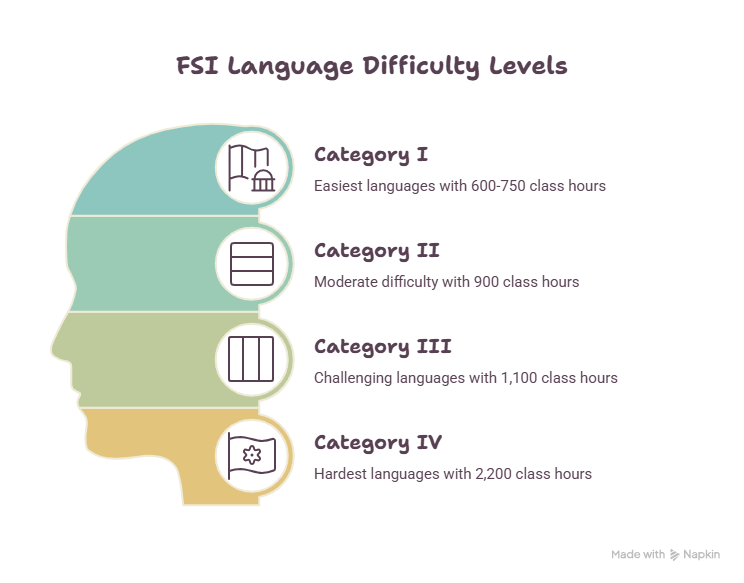
The U.S. Foreign Service Institute has decades of data on this, based on how long it actually takes learners to reach proficiency. Category I languages (closely related to English, including Spanish) take 600 to 750 classroom hours. Category IV languages (Arabic, Mandarin, Japanese, Korean) take roughly 2,200 hours, nearly three times as long. That gap isn’t about motivation or intelligence. It’s the measurable cost of crossing a bigger linguistic distance.
I’ve lived this gap firsthand, and not always in a straight line. Danish is my native language, also Germanic, and English, the main foreign language taught in Danish schools, came easily for the same reason: closely related sound systems.
German was part of the curriculum too, but I never reached real fluency there. Oddly, once I later became fluent in Dutch, German got harder to speak, not easier. Dutch and German sit so close together that my mouth now defaults to Dutch sounds whenever I try to switch, more interference than head start.
French came next, in high school, and that was the first real jump: Germanic to Romance, different vowels, different rhythm, different everything. Years later, moving from Danish and Dutch into Italian, I hit that same wall again as an adult. Vowels that needed to stay pure instead of gliding, a rhythm that stresses syllables differently, consonant clusters my mouth hadn’t built muscle memory for. I still catch myself translating in my head before I speak Italian, something that never happens in Dutch or English anymore.
That said, I want to be precise about what my own experience actually proves. A Germanic-to-Romance jump is a meaningful distance, but it’s nowhere near the distance someone faces moving from English into Korean or Arabic, where the sound system, and often the writing system, share almost nothing with what a European learner already knows. I haven’t personally made that jump, so for that end of the difficulty scale, the research above is the more honest source than my own story.
Does Your Native Language Determine How Hard Pronunciation Will Be?
Yes, to a significant degree, though it sets the starting difficulty, not a ceiling. Your native language determines which sounds you already have muscle memory for and which ones you’re building from zero. It doesn’t determine whether you can eventually get there.
Is a Foreign Accent Actually a Problem?
No, not by itself. As the same 2025 research found, how strong an accent sounds and how easily people understand it are only weakly linked, which directly challenges the old assumption that sounding native is necessary for effective communication. A strong, clearly foreign accent and being easily understood can, and very often do, coexist.
An accent tells people where you’re from. It doesn’t determine whether they understand what you’re saying. Those are two separate things, and only one of them is worth fixing.
This distinction matters because most learners quietly assume the goal is to sound native, and then feel like a failure when they don’t. That’s the wrong target. Being reliably understood, in any accent, is a real and achievable goal. Sounding like you grew up somewhere you didn’t is not, and chasing it wastes energy that’s better spent elsewhere.
If it’s the fear of getting a sound wrong, not the sound itself, that’s keeping you quiet, that’s a separate and equally fixable problem covered in why you’re afraid of making mistakes when speaking a foreign language.
Which Pronunciation Errors Actually Matter
A pronunciation error matters when it changes the meaning of a word or makes it unrecognizable to a listener. It doesn’t matter much when it’s simply a different way of producing a sound that a listener can still parse correctly, even if it sounds foreign.
The clearest way to test this is with minimal pairs: two words that differ by exactly one sound. The concept works the same way in any language, though the specific pairs are different depending on which sounds your target language uses to distinguish meaning.
Minimal Pair Examples That Change Meaning
Language | Pair | What changes | Why it matters |
|---|---|---|---|
English | ship / sheep | vowel length | Different words entirely, listener has to guess from context |
English | live / leave | vowel quality | Verb tense confusion in a sentence |
Dutch | zon / zoon | vowel length (sun / son) | Same sound, held longer, completely different word |
Italian | papa / papà | word stress (pope / dad) | Stress shift alone changes the meaning |
If a sound substitution shows up in a minimal pair like these, it’s worth drilling specifically. If it doesn’t (a slightly different “r” sound that never actually creates a different word, for example) it’s probably just accent color, not a communication problem.
Exercises That Actually Fix Pronunciation Problems
The exercises that actually move the needle are shadowing, minimal pair drilling, and recording yourself, done consistently rather than perfectly.
Shadowing means listening to a short clip of native audio and speaking along with it in real time, matching rhythm and pitch, not just the words. This builds the muscle memory for rhythm and intonation that vocabulary lists never touch.
Minimal pair drilling means practicing the specific pairs that matter for your language combination (from the table above, or ones specific to your target language), rather than every sound that feels unfamiliar.
Recording yourself and listening back is uncomfortable at first, but it’s the only way to catch what you actually sound like versus what you think you sound like. Compare your recording to a native audio clip of the same sentence and listen specifically for the sound you’re targeting.
A simple daily routine: 10 minutes of shadowing, 5 minutes of minimal pair drilling on your specific trouble sounds, and one recorded sentence to review. Consistency here matters more than session length.
If mental translation is also slowing you down before you even get to pronunciation, the fix follows the same repetition logic covered in why you translate in your head before speaking. Pronunciation is also only one piece of the wider comprehension-speaking gap, which why you can’t speak a foreign language despite understanding it breaks down in full.
Tools That Can Help With Pronunciation
Speech recognition apps and AI conversation tools can help by flagging specific sounds you’re getting wrong in real time, something that’s hard to catch on your own. They work best as a supplement to the exercises above, not a replacement for them.
If you want a tool that scores individual sounds in real time rather than general speaking practice, the best AI pronunciation coach apps are built specifically for that. For a full breakdown of which apps actually build speaking output versus which just look good in the app store, see best apps for speaking practice.
How Long Does It Take to Fix Pronunciation Problems?
There’s no single number, because it depends on how far the sound is from anything in your native language and how much focused repetition you give it, not on general fluency level. A sound close to something you already produce can improve within a few weeks of daily drilling. A sound with no equivalent in your native language, especially in a Category IV language pair, can take months of consistent, targeted practice.
For the bigger-picture timeline of reaching overall fluency rather than just clear pronunciation, how long it takes to learn a foreign language lays out realistic hour benchmarks by language category.
Worth reading next
A few more useful guides:
Conclusion
Fixing pronunciation isn’t about erasing every trace of your native accent. It’s about identifying the specific sounds that actually confuse listeners and drilling those, while letting go of the ones that are just accent, not error. Start with one minimal pair that matters for your language combination, shadow it, record yourself saying it, and repeat daily. That’s a far more useful goal than chasing a native accent you don’t actually need.
Frequently Asked Questions
Can pronunciation be improved as an adult?
Yes. Pronunciation is a trainable skill at any age. Adults tend to need more deliberate, targeted practice than children do, but the sound-specific drilling described above works regardless of when you started learning.
Is it harder to fix pronunciation in adulthood vs childhood?
Somewhat, mainly because children absorb sound systems passively through years of exposure, while adults need to consciously target specific sounds. It’s a difference in method, not a ceiling on what’s possible.
What’s the difference between pronunciation and enunciation?
Pronunciation is producing the correct sounds and stress patterns of a language. Enunciation is speaking clearly and distinctly, which matters in any language, including your own native one.
Should I aim to eliminate my accent completely?
No. As covered above, a strong accent and being easy to understand are only weakly related, so a foreign accent doesn’t need to disappear for you to be clearly understood. Aim for clarity, not accent elimination.
Do native speakers actually notice most non-native sound errors?
They notice fewer than most learners assume, and they notice even less when the error doesn’t create a different word. Native listeners generally adapt quickly to a consistent accent within a few sentences.
